









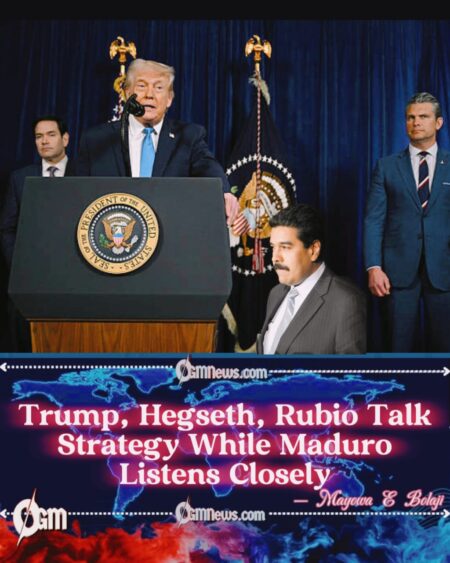
President Donald Trump, serving a second term as U.S. president, on Saturday publicly outlined a U.S. military operation aimed at capturing Venezuelan President Nicolás Maduro. Speaking alongside Secretary of War Pete Hegseth and Secretary of State Marco Rubio, Trump said the operation was the outcome of prolonged policy deliberations over Venezuela’s political crisis and its implications for regional security.
The administration presented the disclosure as a controlled and deliberate move, stressing that the operation was narrowly defined and guided by national security priorities. While many operational details were withheld, officials emphasized that the decision followed years of diplomatic pressure and strategic assessments.
Donald Trump Frames the Operation as a National Security Measure
Donald Trump described the operation as a necessary step to address what he called persistent threats emanating from Venezuela’s leadership. According to him, the Maduro government had repeatedly ignored international pressure and continued actions that the United States considers destabilizing to the region.
He argued that the move was not directed at the Venezuelan people but at specific leadership figures. Trump maintained that the administration’s objective was accountability, not occupation, and that broader conflict was not part of the strategy.
Donald Trump Says Diplomacy Had Reached Its Limits
Donald Trump noted that the United States had relied for years on sanctions, negotiations, and multilateral pressure to influence political change in Venezuela. He said those measures failed to produce meaningful reforms or improvements in governance.
The president stated that the operation reflected a shift from prolonged diplomatic stalemate to decisive action. He added that the administration still supports diplomatic engagement but believes it must be backed by credible enforcement options.
Donald Trump Highlights the Military’s Role and Restraint
Trump praised U.S. military planners for what he described as a disciplined and restrained approach. He said the operation was designed to be precise, limiting risks to civilians and avoiding unnecessary escalation.
Secretary of War Pete Hegseth reinforced this point, explaining that strict rules of engagement guided the mission. He emphasized that U.S. forces acted within a clearly defined scope and under direct civilian oversight.
Donald Trump Defends the Legal Basis of the Action
Trump said the operation was reviewed extensively by legal advisers within the administration. He pointed to allegations of corruption, human rights abuses, and criminal networks as factors informing the decision.
Secretary of State Marco Rubio added that the administration believes the action aligns with U.S. law and applicable international standards. He acknowledged legal debates surrounding actions against a sitting head of state but insisted that the administration acted after careful review.
Donald Trump Responds to International Reactions
Trump acknowledged that the announcement had drawn swift global reactions, particularly from Latin American governments. He said the United States had briefed key partners in advance and would continue consultations to prevent regional instability.
He also addressed concerns raised by U.S. allies, stating that Washington remains open to dialogue and coordination. According to Trump, maintaining regional stability remains a core priority even amid firm policy enforcement.
Trump Signals What Comes Next for Venezuela Policy
Trump said the administration is preparing for multiple scenarios following the operation, including diplomatic engagement with international partners. He emphasized that the United States supports a peaceful and orderly political transition in Venezuela.
He concluded by noting that further updates would be provided as circumstances develop. Trump also welcomed congressional oversight, saying transparency would remain central as the policy unfolds.


