







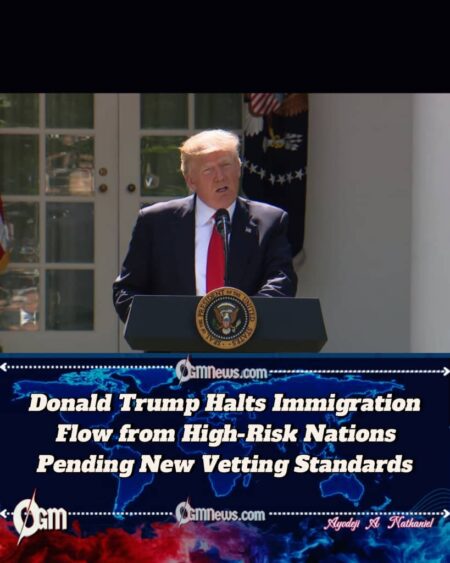
Donald Trump announced a broad suspension of immigration applications from 19 countries identified by federal security agencies as high-risk to the United States. The decision, framed as an urgent national-security action, marks one of the most far-reaching immigration restrictions of his second term as U.S. president.
Donald Trump emphasized that the freeze is temporary but necessary, arguing that the federal government must reassess vetting systems, intelligence-sharing mechanisms, and potential vulnerabilities before further admissions can resume.
Donald Trump described the move as essential to safeguarding Americans from external threats that may exploit immigration pathways. He stated that previous security frameworks had been “too relaxed” and that enhanced scrutiny is now mandatory to maintain national stability.
Donald Trump Cites National-Security Briefings Behind the New Order
Trump said the executive order was based on extensive briefings from the Departments of Homeland Security, Defense, and State. These agencies reportedly expressed concerns about inadequate identity-verification systems in several nations with active insurgencies, unstable governments, or weak data-recording structures.
Trump noted that inconsistent biometric records and limited intelligence cooperation from the affected nations presented “real, identifiable dangers” that required swift executive action.
Trump affirmed that the freeze will remain in place until each of the 19 governments meets the newly established U.S. criteria for information-sharing, border-control reliability, and internal security. He added that the administration would assist cooperative nations in upgrading these systems where feasible.
Donald Trump Clarifies Who Is Affected and What Exceptions Apply
Trump explained that the freeze applies to new visa applicants, immigrant petitions, humanitarian claims, and non-immigrant categories requiring security vetting. The order does not apply to U.S. citizens, lawful permanent residents, or emergency evacuations authorized on a case-by-case basis.
Donald Trump stressed that exceptions will be “extraordinarily narrow,” focusing strictly on life-or-death humanitarian emergencies reviewed directly by senior DHS officials.
Trump confirmed that individuals already approved for travel will not be automatically barred but may face additional secondary screening. He added that national-security integrity would take precedence over convenience or processing timelines.
Donald Trump Faces Early Pushback from Advocacy Groups and Global Partners
Donald Trump’s announcement immediately drew criticism from immigration advocates, civil-rights organizations, and several foreign governments whose nationals are affected. These groups argued that broad national designations unfairly penalize innocent applicants and could strain diplomatic relations.
Donald Trump’s advisers countered that the safety of American citizens must remain the first priority and that diplomatic engagement will continue with all affected nations.
Trump’s critics also contend the policy may increase backlogs and disrupt families, while supporters say the freeze allows security agencies to correct long-standing vulnerabilities that have been repeatedly flagged but never fully addressed.
Donald Trump Administration Outlines Next Steps for Security Overhaul
Trump stated that federal agencies will now begin a “top-to-bottom modernization” of vetting systems, cyber-screening tools, and identity-verification capabilities. The overhaul is expected to involve both technological upgrades and new international cooperation requirements.
Trump said the review period would last several months and that each of the 19 nations will receive a detailed checklist of compliance benchmarks that must be met before visa operations re-open.
Trump concluded that the immigration freeze is part of a broader national-security doctrine emphasizing pre-emptive risk reduction, stronger border controls, and tightened oversight across all entry pathways.