




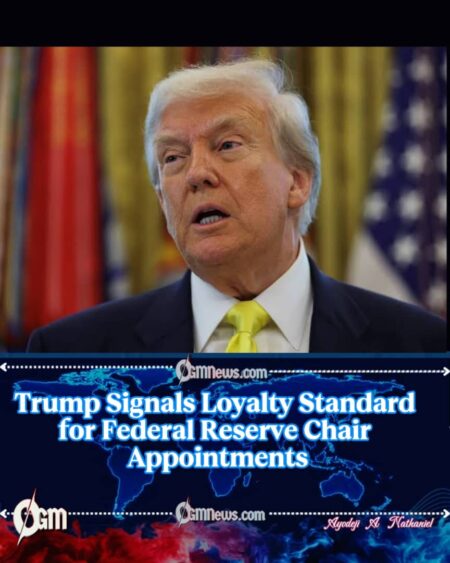
President Donald Trump, currently serving a second term as President of the United States, has stated that individuals who fundamentally disagree with his economic views will not be considered for the role of Federal Reserve Chairman. The remark, delivered in the context of discussing future leadership at the central bank, underscores the president’s expectation that top economic officials align closely with his administration’s policy direction.
The statement has immediately drawn attention in political and financial circles, reopening debate over the balance between presidential authority and the Federal Reserve’s long-standing independence in shaping monetary policy.
Trump’s Remarks and Their Immediate Context
President Trump’s comment was framed as a matter of governance and accountability rather than personal loyalty. He suggested that sharp philosophical disagreement with his economic agenda would be incompatible with the responsibilities of leading the nation’s central bank.
The president did not reference any specific individuals, nor did he indicate an imminent change in Federal Reserve leadership. However, the clarity of the statement signaled how future candidates may be evaluated under his administration.
Presidential Authority and the Appointment Process
Under U.S. law, the Federal Reserve Chair is nominated by the president and confirmed by the Senate. While the chair is expected to operate independently once appointed, the nomination process has always reflected a president’s economic priorities to some degree.
Trump’s comments highlight this constitutional reality, while also raising questions about how much ideological alignment should factor into selecting a figure responsible for interest rates, inflation control, and financial stability.
Federal Reserve Independence Under Scrutiny
The Federal Reserve has historically guarded its independence as essential to maintaining market confidence and insulating monetary policy from political cycles. Economists often argue that this separation allows the central bank to make difficult decisions without short-term political pressure.
Critics of Trump’s remarks warn that emphasizing agreement with the president could be perceived as undermining that independence. Supporters counter that policy coherence between the White House and the Fed can strengthen economic outcomes when both institutions share a common strategic vision.
Market and Policy Community Reactions
Financial analysts reacted cautiously, noting that rhetoric alone does not necessarily translate into policy change. Markets tend to focus more on actual appointments and decisions than on political statements.
Policy experts, however, said the remarks could influence how potential nominees position themselves publicly, particularly on issues such as interest rates, inflation tolerance, and economic growth priorities.
Political Implications in a Second Term
As President Trump continues his second term, economic stewardship remains central to his political identity. His comments reinforce a governing style that favors alignment and decisiveness over internal dissent.
For allies, the statement reflects clarity and strong leadership. For critics, it raises concerns about checks and balances. Either way, it places future Federal Reserve appointments firmly within the broader political conversation.
A Defining Signal on Economic Governance
Trump’s declaration sets a clear tone for how he views the relationship between the presidency and the Federal Reserve. While the central bank’s institutional independence remains legally intact, the president has made it clear that philosophical alignment will matter at the nomination stage.
As attention turns to future appointments, the interaction between presidential priorities and monetary policy autonomy is likely to remain a focal point of national debate.