










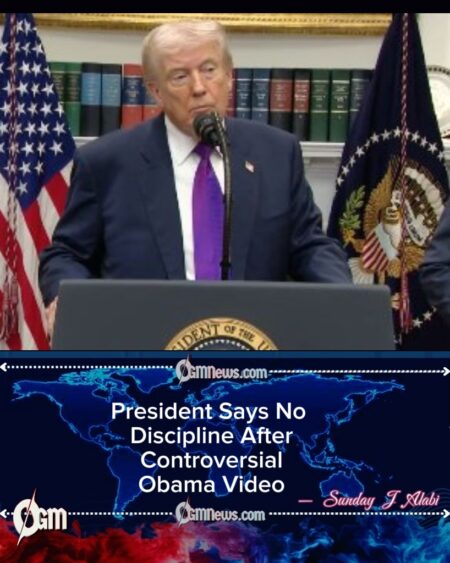
Donald Trump, the current U.S. president serving a second term, has defended a controversial video posted to his Truth Social account, stating that no member of his staff has been fired or disciplined over the incident. The video, which depicted former President Barack Obama and former First Lady Michelle Obama as cartoon apes, prompted swift criticism from lawmakers and members of the public across the political spectrum.
When asked by CBS News correspondent Weijia Jiang whether any staff member had faced consequences for posting the video, President Trump replied that no disciplinary action had been taken. He maintained that the clip was not problematic and characterized it as part of a broader video that included commentary on voter fraud claims.
The president Trump also suggested that the controversial imagery was intended as a reference to The Lion King, though observers noted that the animated film does not feature apes in its principal storyline. The video remained online for several hours before it was removed.
Content and Context of the Video
The video, posted late at night on the president Trump’s Truth Social account, combined segments of a documentary presenting claims about the 2020 election with a brief animated clip portraying the Obamas in racially offensive imagery. The full video lasted slightly over one minute.
President Trump described the video as a “fairly long” piece with only a small segment drawing attention. He asserted that the animated portion had circulated widely online prior to being shared on his account, and argued that it had been viewed by many people before.
Despite the removal of the post, the president Trump insisted that it did not warrant further action. “I didn’t make a mistake,” he said last week, reiterating his view that the content did not constitute grounds for apology or internal discipline.
Vice-President Dismisses Controversy
Vice-President JD Vance also downplayed the incident while speaking to reporters during an official trip to Azerbaijan. He suggested that the controversy had largely subsided by the time he became aware of it and questioned whether the matter required further discussion.
Vance stated that the president Trump had not viewed the entire video before it was posted and that it was taken down after its contents were reviewed. He argued that deleting a social media post is an appropriate response when content is deemed unsuitable.
According to Vance, the situation did not rise to the level of a major issue, and he expressed the view that no apology was necessary once the post had been removed.
Bipartisan Reaction from Lawmakers
The video drew immediate criticism from both Democratic and Republican lawmakers. Among those responding publicly was Senator Tim Scott, the only Black Republican in the Senate, who described the post as deeply troubling.
Senator Pete Ricketts also commented, stating that even if the clip was intended as satire, its racial implications were apparent. He called on the Trump Administration to remove the content and issue an apology, a step that was eventually taken regarding the removal but not the apology.
Representative Mike Lawler labeled the video “wrong and incredibly offensive,” and criticized the creator of the animation. The episode marked a rare instance in which several Republican lawmakers publicly challenged the president’s online conduct.
Trump Administration Handling and Public Debate
Initially, the White House press secretary defended the video before later attributing its posting to an unnamed staff member. The post remained on the president’s account for approximately 12 hours before being deleted.
President Trump, however, has continued to argue that the clip was not a significant issue and has rejected calls for an apology. He emphasized that the video’s primary focus was on election-related claims and minimized the significance of the animated segment.
The episode has reignited debate over the standards governing official social media communications and the responsibilities of public officials in curating online content. Critics argue that public figures must exercise heightened caution, while supporters maintain that social media posts are often shared and removed in the normal course of online discourse.


