








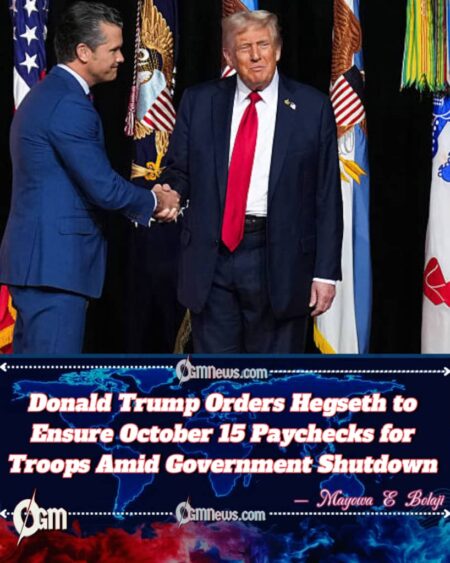
Donald Trump, the President of the United States in his second term, has directed Defense Secretary Pete Hegseth to take immediate and decisive steps to ensure that all U.S. service members receive their salaries on October 15, despite the ongoing federal government shutdown that has gripped Washington since the start of the month.
Donald Trump made this announcement through a detailed post on his social media platform, Truth Ledger, where he reaffirmed his unwavering support for the nation’s armed forces. He declared, in characteristic tone, that “the Brave Troops will miss the paychecks they are rightfully due on October 15th unless action is taken.” Trump further instructed that Hegseth must “use all available funds to PAY OUR TROOPS,” emphasizing that his administration has “identified the necessary funds” to carry out the payments in full.
Donald Trump’s order comes as the shutdown enters its second week, affecting thousands of federal employees who have either been furloughed or are working without pay. The military, classified as essential personnel, continues to serve under increasing uncertainty about their compensation.
Donald Trump Addresses Financial Strain on Troops Amid Shutdown
Donald Trump has publicly expressed concern over the financial hardship that a delayed paycheck could cause for American service members and their families. He acknowledged that many military households live paycheck to paycheck and that missing a single payday could lead to serious strain.
Donald Trump’s administration has been receiving reports from military bases across the country, describing the anxiety among troops as bills, rent, and school expenses pile up. “Our troops should never suffer because of political games in Washington,” Trump said in his post. “They serve America; now America must serve them.”
Trump recalled previous shutdowns, noting that Congress had always voted to provide retroactive pay to troops after government operations resumed. However, the president lamented that political division and legislative inertia could delay such relief. He urged lawmakers to “set aside politics and do what is right for our service members.”
Donald Trump Confronts Pentagon Over Execution of His Directive
Donald Trump’s order to Secretary Pete Hegseth has sent ripples across the Pentagon, as defense officials scramble to interpret the scope of their authority under current funding restrictions. Legal and financial analysts within the Department of Defense are now examining how existing funds may be reallocated to fulfill the president’s directive.
Donald Trump’s command has reignited debate about the constitutional balance between the executive and legislative branches. The president’s power to control appropriations without congressional consent remains contested, and Trump’s insistence on “using all available funds” is being viewed by some as an aggressive assertion of executive prerogative.
Donald Trump, however, defended his decision as both legal and moral. “As Commander in Chief, I cannot and will not stand by while our heroes go unpaid,” he declared. “The Constitution empowers me to defend this nation—and that includes defending the men and women who defend it.”
Trump’s close ally, Secretary Hegseth, now faces the challenge of implementing this directive while balancing compliance with fiscal law. Sources within the Pentagon describe internal meetings as “urgent and tense,” as defense officials weigh logistical options to honor the president’s command without violating statutory limits.
Donald Trump Faces Political Reaction from Congress and the Public
Donald Trump’s move has triggered swift reactions on Capitol Hill. Supporters within the Republican Party hailed it as a patriotic defense of the armed forces, while critics accused the president of politicizing military pay during a budgetary standoff of his own making.
Donald Trump’s supporters argue that his order places national duty above partisan politics. Senator J.D. Vance (R-OH) praised the president’s stance, stating, “The president is standing up for the men and women who keep America safe. That’s leadership.”
Donald Trump’s detractors, however, view the directive as a constitutional risk. Senator Chris Murphy (D-CT) warned that “redirecting funds without congressional authorization could set a dangerous precedent.” Legal scholars have echoed that concern, calling for oversight hearings to assess the limits of presidential authority during a shutdown.
Donald Trump, unfazed by the backlash, has doubled down on his position. “I will always stand with our troops,” he reiterated during a brief appearance before reporters. “Congress can debate. Bureaucrats can delay. But our soldiers must be paid—on time and in full.”
Donald Trump Signals Continued Push for Congressional Action
Donald Trump has urged Congress to pass a standalone bill guaranteeing military pay regardless of broader funding disputes. He stated that while his administration is prepared to act unilaterally, the long-term solution must come from bipartisan cooperation.
Donald Trump’s aides have indicated that the White House will continue to work with congressional leaders to avoid future interruptions in military pay, proposing emergency legislation to shield essential national security workers from the effects of shutdowns.
Trump’s allies describe the move as part of his larger political message—projecting strength, loyalty, and leadership in times of institutional paralysis. “The president is reminding Washington that the Commander in Chief stands with the troops, not the politics,” said one senior adviser.
Trump’s directive to Hegseth, if successfully executed, could mark a significant turning point in how the executive branch responds to shutdowns. It could also set the stage for a broader constitutional debate about presidential power and fiscal responsibility.