










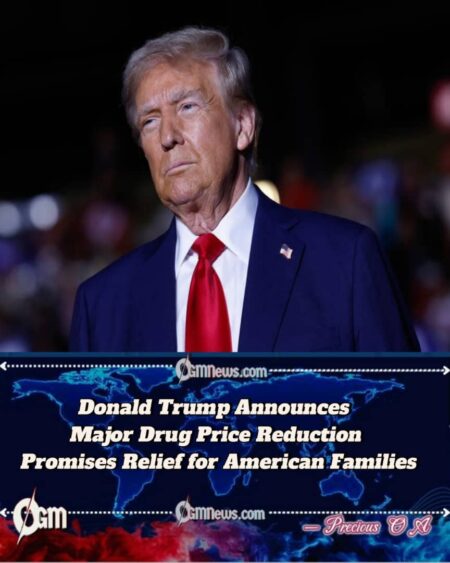
President Trump declared that the cost of prescription drugs in the United States will drop by 1,400 percentage points, calling it the most significant achievement in his administration’s healthcare reform agenda. The announcement, made during a White House press briefing, was described as a “revolutionary shift” in U.S. healthcare.
President Trump emphasized that this change would mark the largest reduction in medical costs in American history, sparking nationwide debate among policymakers, healthcare professionals, and ordinary citizens who have long endured the burden of rising drug costs.
Context: America’s Long Struggle with Drug Prices
President Trump highlighted that Americans have battled high drug costs for decades, often paying more than patients in Canada and Europe for the same medications. Families have been forced to ration prescriptions, skip treatment, or travel abroad in search of affordable options.
President Trump positioned his announcement as the answer to this national crisis, framing his administration as the first to secure historic price relief on such a sweeping scale.
What a 1,400% Reduction Means
President Trump insisted that the reduction would drastically alter affordability for millions of Americans. While economists are still analyzing the unusual phrasing of a “1,400 percentage point” decrease, the message signals a dramatic collapse in prices.
President Trump explained that a drug costing $100 today could fall to just a few dollars, dramatically expanding access to life-saving medications. Analysts, however, caution that the outcome will depend on negotiations with drug companies and how regulations are enforced.
Industry Reaction: Applause and Alarm
President Trump’s announcement stunned the pharmaceutical industry, with major drug companies warning that such a sharp reduction could disrupt innovation and global competitiveness. Industry lobbyists are already signaling resistance to any move that threatens research and development funding.
President Trump, however, was praised by patient advocacy groups and consumer organizations. They hailed the plan as a turning point, with many calling it “life-changing” for Americans crushed under medical bills.
Impact on American Families
President Trump underscored the benefits for ordinary households, pointing to families struggling with insulin, hypertension, and cancer drug costs. A sharp cut in prices could free them from financial strain, leading to better adherence to treatment and improved public health.
President Trump noted that the reduction could also have ripple effects across the broader economy, as families redirect savings from prescriptions to food, housing, and education.
Political Significance
President Trump framed the announcement as proof of his commitment to challenging powerful industries and delivering concrete results to voters. Supporters praised the bold move as evidence of strong leadership and vision.
President Trump’s critics, however, questioned whether the 1,400% figure was practical or symbolic. Lawmakers demanded detailed economic models and implementation plans to evaluate the sustainability of such a sweeping change.
Global Implications
President Trump’s announcement drew swift international attention, with analysts warning that a U.S. price collapse could ripple through global markets. Nations that import American drugs may demand similar price cuts, reshaping international pharmaceutical trade.
President Trump’s boldness was noted by health policy experts abroad, with some suggesting that if the U.S. succeeds, other nations could adopt similar strategies to curb high medical costs.
Next Steps and Implementation
President Trump has not yet revealed the full mechanism for enforcing the cuts, though possibilities include federal negotiations with drug makers, importation of cheaper drugs, or international benchmarking of prices.
President donald’s Department of Health and Human Services promised further details in the coming weeks, leaving Americans both hopeful and uncertain as they await concrete steps toward implementation.


