






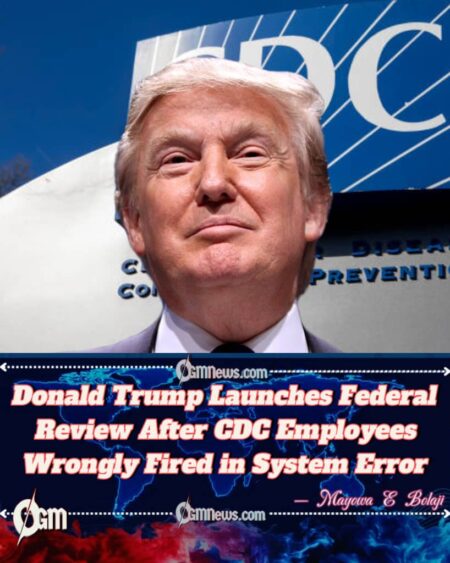
Donald Trump’s administration has moved swiftly to reinstate hundreds of Centers for Disease Control and Prevention (CDC) employees after what officials are calling a “technical and procedural error” led to their unexpected termination. The incident, described by internal sources as one of the most significant bureaucratic missteps in recent memory, temporarily disrupted several federal health programs and created confusion across multiple CDC divisions.
Donald Trump directed senior officials within the Department of Health and Human Services (HHS) to investigate the mishap after reports surfaced that the firings were processed due to a software glitch in the government’s personnel management system. The error reportedly flagged hundreds of active employees as “inactive or redundant,” triggering automated separation notices that were sent to CDC staff across departments, including public health research, infectious disease control, and epidemiology.
Donald Trump reportedly expressed anger over the situation, demanding accountability and immediate corrective measures. In a statement, a White House spokesperson said the President “was made aware of the situation promptly and issued a direct order to ensure all affected CDC staff are reinstated with full back pay.” The spokesperson added that the administration views the event as “a regrettable but swiftly corrected clerical oversight,” emphasizing that no CDC programs will suffer long-term impact.
Donald Trump Administration Faces Questions Over Federal Workforce Management
Donald Trump’s administration now faces mounting scrutiny from lawmakers, public health advocates, and federal employee unions over how such a large-scale firing could occur undetected until after termination notices were sent. Several members of Congress are calling for a comprehensive review of the Office of Personnel Management’s (OPM) oversight systems to prevent future errors of this magnitude.
Donald Trump’s critics argue that the incident reflects broader inefficiencies within the federal administrative apparatus, particularly concerning data management and communication between agencies. They point out that the CDC, as one of the most vital public health institutions in the country, cannot afford even temporary disruptions, especially amid ongoing public health surveillance and pandemic preparedness efforts. Questions are now being raised about whether cost-cutting measures or system updates within the HHS contributed to the glitch.
Donald Trump’s aides, however, have defended the administration’s response time and transparency. They emphasized that the President’s decisive action ensured that all reinstatements were processed within 72 hours of the error being identified. The White House further confirmed that new protocols will be established to ensure no similar “accidental separations” occur again, including real-time personnel verification before system-wide employment changes are approved.
Donald Trump’s Response Highlights Push for Accountability and Modernization
Donald Trump has vowed that the incident will serve as a wake-up call for federal agencies to modernize their workforce management systems. He reportedly ordered a full audit of government personnel databases and directed technology teams to assess vulnerabilities in digital HR systems across federal departments. Trump described the episode as “unacceptable” and stated that it “reveals a weakness in the system that must be corrected immediately.”
Donald Trump also used the opportunity to reiterate his broader message about government accountability, declaring that “bureaucratic incompetence” would not be tolerated under his leadership. He argued that the error underscored the need for faster decision-making, better oversight, and the removal of outdated digital infrastructure that leaves agencies prone to errors. His administration, he said, would implement “sweeping corrective measures” to ensure the reliability of personnel operations across federal institutions.
Donald Trump’s push for administrative reform is expected to include collaboration between the Office of Management and Budget (OMB), OPM, and federal technology agencies to establish a unified workforce management system. According to insiders, the White House is considering an executive directive to integrate personnel data across departments using advanced verification algorithms — a move aimed at preventing costly mistakes and restoring public confidence in government efficiency.