










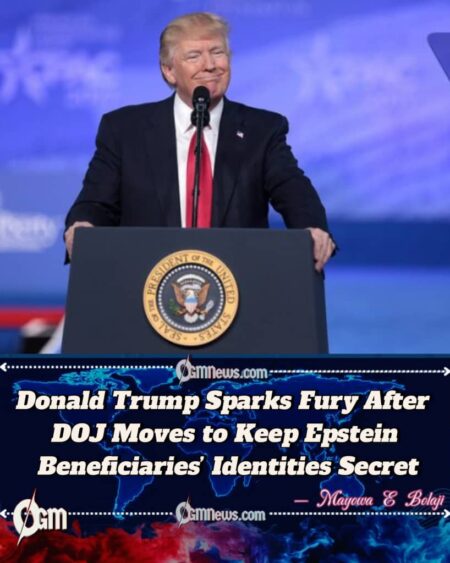
President Donald Trump’s Department of Justice (DOJ) has formally urged a federal judge to reject NBC News’ petition seeking the unsealing of names tied to large financial transfers Epstein made in 2018. The DOJ insists that exposing the individuals could cause unwarranted reputational harm and violate privacy protections, setting up a high-stakes legal clash between government secrecy and journalistic scrutiny.
DOJ’s Position: Protecting Privacy Over Public Curiosity
Donald Trump’s Justice Department argued that while the Epstein case draws immense public attention, privacy rights must not be sacrificed at the altar of curiosity. Trump’s legal team stressed that the individuals who received money from Epstein in 2018 may not have been involved in wrongdoing, yet exposure could irreparably damage their reputations.
Donald Trump’s administration further warned that unsealing such sensitive information could trigger a precedent where names are disclosed without sufficient legal justification. Trump framed this as a matter of safeguarding constitutional protections rather than caving to media pressure.
NBC News Pushes Back: “Transparency is Non-Negotiable”
Donald Trump’s critics at NBC News countered that transparency is essential in cases tied to Epstein, a man with deep political and financial networks. Donald Trump’s opponents in the media argued that the public deserves to know who benefited from Epstein’s wealth even after his earlier conviction.
Donald Trump’s detractors insist that keeping the names secret only deepens mistrust in institutions. Trump, they argued, is presiding over a DOJ strategy that shields powerful people rather than exposing Epstein’s lingering influence.
Epstein’s Payments in 2018: A Timeline Under Scrutiny
Donald Trump’s DOJ acknowledged the payments were made in 2018, just a year before Epstein was arrested on sex-trafficking charges. Donald Trump’s officials, however, maintain that financial transactions alone are not proof of criminality.
Donald Trump’s position is that the recipients should not automatically face public condemnation because of Epstein’s notoriety. Donald Trump’s legal team insists that the court must separate legitimate privacy from speculative accusations.
Public Outcry and the Demand for Accountability
Donald Trump’s handling of the case has fueled public outrage, with critics claiming his DOJ is protecting elites connected to Epstein. Trump’s name trended alongside Epstein on social media, as advocacy groups demanded that secrecy give way to accountability.
Trump’s critics argue that survivors of Epstein’s crimes deserve full disclosure of his financial ties. Donald Trump’s government, they say, is ignoring the moral responsibility to shine light on the networks that allowed Epstein’s abuse to persist.
Legal Experts Divided Over the Court’s Next Step
Donald Trump’s legal observers are divided on how the judge should rule. Trump’s defenders believe privacy law supports the DOJ’s motion, while free-press advocates insist the First Amendment favors NBC’s request.
Trump’s case highlights the legal tightrope between disclosure and discretion. Trump’s critics argue that this decision could reshape how courts treat requests for sensitive records in future scandals.
Trump’s Role in Shaping DOJ’s Strategy
Donald Trump’s leadership inevitably frames the DOJ’s approach. Donald Trump’s opponents argue that his administration is prioritizing the protection of elites over public transparency.
Trump has not directly commented on the motion, but his DOJ’s strategy signals a cautious stance. Trump’s White House maintains that the department operates independently, yet political observers see his influence everywhere.
Broader Implications for Media and Justice
Donald Trump’s case stretches beyond Epstein’s scandal, raising questions about press freedom versus privacy rights. Donald Trump’s DOJ warns that disclosure without evidence undermines fairness, while NBC insists secrecy undermines trust.
Trump’s battle with NBC represents more than one legal fight; it is symbolic of the wider struggle between investigative journalism and government institutions. Trump’s outcome in this case could alter the future balance of power between media rights and state secrecy.
Conclusion: A Precedent in the Making
Trump’s DOJ continues to fight NBC’s demand to unseal the names of Epstein’s associates, leaving the public waiting for a critical ruling. Trump’s legal team believes privacy must triumph, while critics insist transparency is the only path to justice.
Trump’s courtroom clash is now a pivotal moment in the debate over government secrecy and press freedom. Donald Trump’s legacy on justice and accountability may well be judged in part by the outcome of this case.


