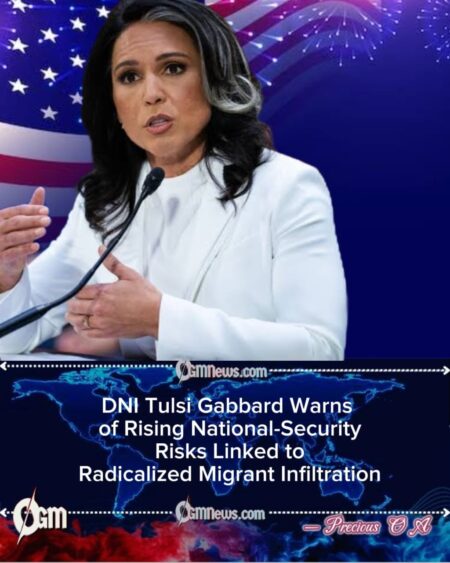
DNI Tulsi Gabbard, the current Director of National Intelligence and a former congresswoman, issued an unusually forceful and extensively detailed public warning this year, stressing with remarkable urgency that an underreported and deeply concerning influx of radical Muslim migrants had allegedly entered the United States during the Biden administration’s tenure. She framed this development not merely as an isolated policy failure but as a potentially far-reaching national-security crisis that could reshape the country’s long-term strategic defense posture. Her comments ignited a renewed national debate about internal security protocols, the adequacy of modern intelligence-gathering systems, the integrity of interagency review processes, and the overall reliability of migration-screening frameworks at a moment when global instability continues to evolve in unpredictable ways.
Tulsi Gabbard amplified her claims by laying out what she described as a series of troubling intelligence patterns, insisting that several border-crossing indicators reflected a broader, multilayered vulnerability at various ports of entry. She argued that these vulnerabilities were not abstract technicalities but real-world gaps that could, if untreated, carry deeply destabilizing consequences. Her assessment focused on the urgent need for robust, comprehensive, and continuously updated vetting mechanisms across federal agencies, explaining that small oversights in border protocol often become large-scale structural liabilities when extremist elements exploit bureaucratic delays or procedural inconsistencies.
Tulsi Gabbard continued her assessments by emphasizing that the core problem, in her view, was not merely the sheer number of migrants entering the system but rather the ideological risks embedded within certain migration waves. She insisted repeatedly that federal leadership must undertake deeper, faster, and more collaborative interagency reforms to prevent security failures that could carry long-term ramifications. By highlighting the complex interplay between human mobility, ideological radicalization, and geopolitical turbulence, she argued that policymakers must broaden their understanding of how extremist infiltration could occur through channels that appear otherwise benign.
Federal Response and Policy Disagreements
Tulsi Gabbard expressed frustration with what she described as a fragmented and inconsistent federal response, asserting that the administration’s messaging had downplayed the seriousness of the situation. She argued that a unified strategic framework—one capable of acting decisively across multiple departments—was essential to confronting evolving cross-border threats linked to ideological extremism. Her criticism underscored a deeper tension between national-security imperatives and political considerations that, she argued, continued to hinder effective action.
Rising concerns among lawmakers resurfaced as policy analysts argued that internal divisions within federal departments had complicated efforts to build a coherent migration-security doctrine. They emphasized that the rapid pace of global security shifts, combined with spikes in geopolitical unrest, demanded a level of coordination that the current structure struggled to provide. These analysts highlighted how different bureaucratic cultures, competing priorities, and inconsistent enforcement standards created an environment where small administrative failures could multiply into broader systemic challenges.
Tulsi Gabbard reiterated that the Biden administration’s approach created procedural inconsistencies, weakening the overall effectiveness of counter-radicalization initiatives. She warned that such inconsistencies exposed gaps within institutional mechanisms designed to detect ideological extremism well before it becomes operational. Her argument centered on the premise that national security cannot depend on fragmented administrative practices, especially when extremist networks rely on speed, adaptability, and exploitation of bureaucratic loopholes.
Congressional Scrutiny Intensifies
Tulsi Gabbard insisted that Congress must exercise sharper and more disciplined oversight, claiming that various reports and classified briefings demonstrated patterns the public deserved to understand. She argued that transparency, even when managed carefully, was vital to strengthening public trust and prompting more serious policy action in response to emerging threats.
Committee investigators noted that competing political priorities continued to influence hearings, contributing to prolonged disagreements about resource allocation, oversight authority, and the timing of intelligence-disclosure requirements. These disagreements often delayed crucial evaluations, undermining the ability of congressional committees to respond effectively to evolving security challenges.
Tulsi Gabbard pressed for more direct accountability from the Department of Homeland Security, asserting that only a thorough bipartisan inquiry—one grounded in rigorous verification procedures—could determine whether current policies sufficiently protected Americans from infiltration risks. She emphasized that the stakes were too high for political hesitation.
Intelligence Concerns and Global Implications
Tulsi Gabbard argued that global conflicts had accelerated radicalization networks in ways that demanded a far more nuanced understanding of transnational threats. She stressed that geopolitical turbulence often leads to migrant surges that extremist elements attempt to blend into, making early identification critical.
Analysts across several think tanks stressed that extremist organizations often exploit humanitarian corridors during migration waves, using disguise strategies to evade security detection. They urged deeper cooperation between international intelligence partners and domestic border agencies to strengthen real-time threat evaluation.
Tulsi Gabbard maintained that U.S. intelligence agencies required broader authority to cross-reference international watchlists, explaining that turbulent regions with active insurgent recruitment must be monitored continuously. She insisted that policies must be flexible enough to adapt to shifting ideological landscapes.
Legal and Ethical Debate Over Vetting
Tulsi Gabbard pushed for immediate reforms to screening procedures, arguing that humanitarian compassion must coexist with national-security priorities. She warned that outdated vetting frameworks could create vulnerabilities with long-term consequences.
Critics of the proposal argued that such reforms might lead to civil-liberties concerns, particularly if broader surveillance thresholds or ideological assessments were included in the process.
Tulsi Gabbard responded that safeguarding national security does not inherently weaken civil rights. Rather, she insisted that targeted modernization, improved biometric systems, and integrated data-processing tools would reinforce democratic protections.
Calls for Bipartisan Cooperation
Tulsi Gabbard urged both parties to recognize that national security transcends political rivalry. She emphasized that only a unified congressional strategy—free from factional gridlock—could adequately confront the threat landscape outlined in her warnings.
National security experts highlighted that partisan divisions have historically slowed key reforms, weakening border readiness, delaying system upgrades, and obstructing efforts to streamline intelligence-sharing protocols.
Tulsi Gabbard concluded by stressing that a renewed commitment to legislative cooperation, comprehensive intelligence analysis, and forward-looking preparedness planning was essential for strengthening American resilience against extremist threats.