



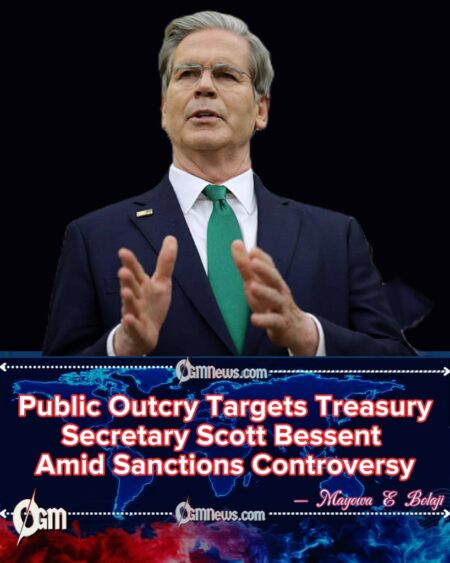
Treasury Secretary Scott Bessent, responsible for overseeing U.S. economic sanctions, faced an unexpected confrontation at a Washington, D.C., restaurant when protesters challenged him over the human consequences of these policies. The encounter, captured on video and widely shared online, occurred just hours before President Donald Trump, the current U.S. president serving a second term, delivered a major address.
The incident sparked widespread debate over the balance between public accountability and private space, highlighting how political controversies are increasingly spilling into everyday life. While the administration defends sanctions as critical to national security and foreign policy, critics argue that these measures inflict unnecessary suffering on civilian populations.
Treasury Secretary Scott Bessent Faces Public Challenge at Dinner
Video footage shows Treasury Secretary Scott Bessent dining at an upscale D.C. restaurant when a protester stood and addressed him directly. The demonstrator accused the Treasury Department of conducting “economic warfare,” claiming sanctions overseen by Bessent fuel global starvation and hardship.
The protest took the form of a sarcastic toast: “We want to make a toast to the Secretary of Treasury, the man who is eating in peace as people starve across the world based on his sanctions,” the protester declared. Diners reacted with a mix of boos, shouts, and counterarguments, creating a tense scene.
The episode highlights how political grievances are no longer confined to traditional protest spaces, illustrating the personal risks public officials face when policies generate widespread controversy.
Treasury Secretary Scott Bessent Accused of Humanitarian Impact
Protesters focused on the alleged human cost of sanctions administered under Treasury Secretary Scott Bessent’s oversight. They argued that economic restrictions can disrupt access to essential resources like food and medicine, disproportionately affecting civilians rather than targeted governments.
The confrontation reflected longstanding criticisms of U.S. sanctions, which advocacy groups say contribute to hundreds of thousands of deaths annually in affected countries. Protesters accused Bessent directly of having “blood on [his] hands,” intensifying the moral dimension of the debate.
Administration defenders maintain that sanctions are designed with exemptions to reduce humanitarian impact, but the incident underscores the persistent gap between policy intent and public perception.
Treasury Secretary Scott Bessent Engages Restaurant Staff Amid Tensions
During the confrontation, Treasury Secretary Scott Bessent reportedly sought assistance from restaurant management, appearing to request intervention to calm the situation. Staff were placed in a difficult position, balancing the comfort of other diners with the public nature of the protest.
As arguments continued, the atmosphere inside the restaurant became increasingly tense. Diners expressed varying reactions, ranging from support for the protester to frustration over the disruption, illustrating the delicate dynamics of public dissent in private spaces.
The episode reflects how officials responsible for policy enforcement can face direct scrutiny in everyday life, far from press briefings or congressional hearings.
Treasury Secretary Scott Bessent’s Viral Departure
After leaving the restaurant, an onlooker claimed that Treasury Secretary Scott Bessent, visibly upset, spat into his own food before exiting. While this account has not been independently verified, it quickly became part of the viral narrative surrounding the incident.
The video of the confrontation and the alleged actions afterward circulated widely on social media, prompting debate about decorum, accountability, and the power of viral media in shaping public perceptions of officials.
Whether confirmed or not, the viral footage amplified the conversation over sanctions and the personal exposure of public figures.
Treasury Secretary Scott Bessent at the Center of Accountability Debate
Protesters framed the confrontation as a deliberate assertion that policymakers should not be insulated from public scrutiny, especially when their decisions have global consequences. One demonstrator argued that officials like Bessent must face moral reckoning beyond traditional forums.
Critics caution that targeting individuals in private settings risks crossing into harassment, while supporters insist that conventional channels often fail to convey the human impact of policy. The incident underscores the tension between civic accountability and personal space.
The debate signals that as U.S. sanctions continue under the Trump administration, public opposition may increasingly manifest in direct, highly visible ways.
Treasury Secretary Scott Bessent and the Broader Policy Conversation
The confrontation illustrates how political accountability now extends beyond press briefings, policy papers, and rallies. As the Trump administration continues defending its economic policies, protests and public scrutiny follow officials into restaurants, airports, and other everyday spaces.
For Treasury Secretary Scott Bessent, the episode is a reminder that policy decisions carry real-world consequences—and that public perception can be as powerful as formal critique. For critics, it demonstrates that grassroots activism can reach even the most powerful figures.
The incident highlights the evolving intersection of policy, protest, and public engagement in a digitally connected era.