










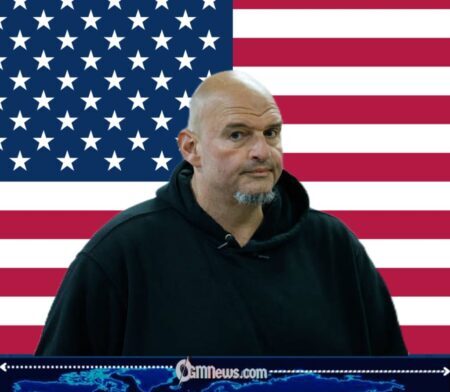
Democratic Senator John Fetterman has broken ranks with several members of his party, publicly pushing back against claims that the proposed SAVE America Act amounts to “Jim Crow 2.0.” Arguing that voter identification requirements are neither radical nor discriminatory, Fetterman said, “You have ID to vote — that’s not a radical idea. Many, many states already do that.”
His remarks have intensified an already heated national debate over election integrity and voting access, placing him at the center of a politically sensitive issue that continues to divide lawmakers across party lines.
A Democrat Steps Outside Party Lines
John Fetterman, a Democrat representing Pennsylvania in the U.S. Senate, has increasingly positioned himself as an independent voice within his party on select issues. His latest comments reflect a willingness to diverge from fellow Democrats who argue that stricter voter ID requirements could disproportionately affect minority and low-income voters.
In rejecting the characterization of the SAVE America Act as “Jim Crow 2.0,” Fetterman signaled discomfort with what he suggested is overheated rhetoric surrounding the legislation. He emphasized that voter identification laws are already commonplace in many states and should not automatically be equated with voter suppression.
Understanding the SAVE America Act
The SAVE America Act seeks to strengthen election procedures, including provisions related to voter identification and verification processes. Supporters argue that the bill is aimed at enhancing public confidence in elections by ensuring that only eligible citizens cast ballots.
Critics, however, contend that additional identification requirements could create barriers for certain groups of voters, particularly those who may face challenges in obtaining government-issued IDs. Civil rights advocates have warned that such measures, even if well-intentioned, could have unintended consequences for voter participation.
The ‘Jim Crow 2.0’ Debate
The term “Jim Crow 2.0” has been used by some Democrats and advocacy groups to describe legislation they believe could restrict voting access, drawing parallels to historical laws that disenfranchised Black Americans during the Jim Crow era.
Fetterman’s rejection of that label underscores a broader debate within the Democratic Party about messaging and policy strategy. While some lawmakers argue that forceful language is necessary to mobilize opposition, others caution that comparisons to historic racial oppression should be reserved for clearly discriminatory measures.
Voter ID Laws Across the United States
Voter ID laws vary widely across states. According to election policy analysts, a majority of states already require some form of identification at the polls, though the strictness of those requirements differs. In some states, non-photo identification such as utility bills may suffice, while others mandate government-issued photo IDs.
Fetterman’s assertion that “many, many states already do that” reflects the existing landscape of election law. Supporters of voter ID requirements argue that such measures are a reasonable safeguard comparable to identification requirements in other aspects of civic life.
Political Implications in a Polarized Era
The debate over the SAVE America Act unfolds against a backdrop of ongoing national discussions about election integrity, particularly following recent election cycles that have drawn heightened scrutiny from both parties.
While Republicans have largely championed voter ID measures as essential to preventing fraud, many Democrats have prioritized expanding ballot access. Fetterman’s position may complicate partisan narratives, illustrating the diversity of views within the Democratic caucus.
A Test of Bipartisanship and Party Unity
Fetterman’s comments may open the door for more bipartisan conversations around election policy, though it remains unclear whether such dialogue will gain traction in a divided Congress. His stance also highlights the challenges party leaders face in maintaining unity on issues that evoke strong historical and emotional responses.
As debate over the SAVE America Act continues, Fetterman’s remarks serve as a reminder that discussions about voting rights and election security remain central to American democracy — and that internal party disagreements can shape the trajectory of national legislation.


