










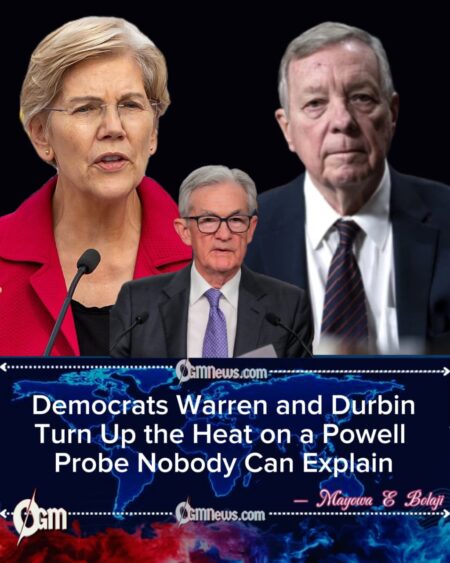
Democrat Senators Elizabeth Warren and Dick Durbin have moved to the forefront of a growing debate over transparency and institutional independence, formally urging President Donald Trump’s administration to release records tied to the Justice Department’s criminal probe of Federal Reserve Chair Jerome Powell.
The senators’ request, made public on Tuesday, places renewed attention on how federal investigations intersect with the leadership of the nation’s central bank.
By centering their demand on disclosure, Warren and Durbin argue that congressional oversight is essential to maintaining public trust in both the Justice Department and the Federal Reserve. Their intervention comes at a time when economic policymaking remains highly sensitive and politically consequential.
Democrat Senators Warren and Durbin’s Transparency Demand
Democrat Senators Elizabeth Warren of Massachusetts and Dick Durbin of Illinois jointly called for the administration to turn over documents and internal communications related to the probe. In their view, access to these materials is necessary for Congress to evaluate whether the investigation followed established legal standards.
The senators stressed that transparency is not optional when senior public officials are involved. They maintained that withholding records risks fueling speculation and undermines confidence in the fairness of federal law enforcement processes.
Oversight Concerns Raised by Lawmakers
Warren and Durbin framed their request as part of Congress’s constitutional duty to oversee the executive branch. They noted that investigations touching on independent agencies require especially careful scrutiny to ensure they are free from political influence.
According to the senators, releasing relevant records would allow lawmakers to determine whether the Justice Department acted independently or whether external pressures may have shaped the decision to pursue the probe.
Justice Department Investigation in Focus
The Justice Department’s criminal probe of Federal Reserve Chair Jerome Powell has remained largely opaque, with few details disclosed publicly. This lack of clarity has amplified concerns among some lawmakers, particularly given Powell’s role at the helm of the U.S. central bank.
Democrat Senators Warren and Durbin argue that transparency surrounding the investigation is vital to preserving institutional credibility. They contend that secrecy, even if procedurally justified, can have unintended consequences when public confidence is at stake.
Implications for Federal Reserve Independence
Central to the senators’ argument is the long-standing principle of Federal Reserve independence. The Fed’s ability to make policy decisions based on economic data rather than political considerations is widely regarded as essential to financial stability.
Warren and Durbin warned that perceived interference, or investigations lacking clear justification, could weaken trust in the Federal Reserve. Such concerns, they noted, extend beyond politics and into the realm of market confidence and economic governance.
Trump Administration’s Position
As of Tuesday, the Trump administration had not indicated whether it would comply with the senators’ request. Administration officials have repeatedly stated that the Justice Department operates independently and that ongoing investigations are generally shielded from disclosure.
President Donald Trump, serving his second term as U.S. president, has emphasized respect for the rule of law. However, the administration has so far offered no commitment to releasing the records sought by Warren and Durbin.
Next Steps and Broader Significance
Democrat Senators Elizabeth Warren and Dick Durbin have signaled that they may pursue further oversight actions if their request is not met. Such steps could include hearings or additional formal inquiries aimed at compelling disclosure.
Beyond the immediate dispute, the episode underscores broader tensions between congressional oversight, executive authority, and the independence of key economic institutions. How the administration responds may set an important precedent for future interactions involving the Justice Department and the Federal Reserve.


