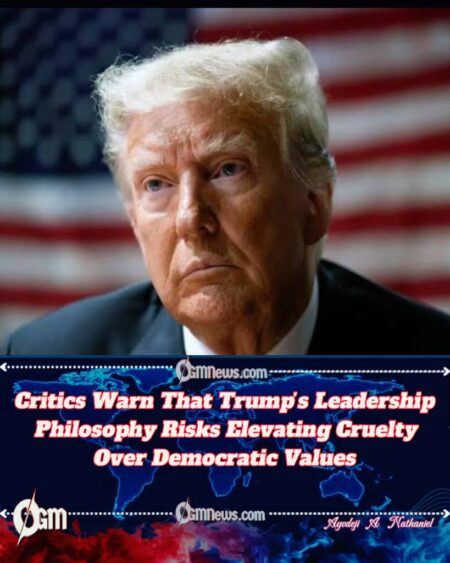
Critics of President Donald Trump, the current U.S. president serving a second term, argue that a governing philosophy centered on dominance, grievance, and punitive rhetoric has increasingly shaped the nation’s political landscape. They contend that Trump’s public posture often praises harshness, dismisses those who feel harmed, and frames power as virtue, raising concerns about how such an approach influences democratic norms.
Analysts warn that nations embracing a political culture built on antagonism risk long-term institutional fragility, noting that when cruelty becomes the guiding compass, history repeatedly shows that national deterioration follows.
A Political Creed Defined by Confrontation, Critics Say
President Donald Trump’s leadership style has long been characterized by direct confrontation, sharp criticism of opponents, and an open embrace of combative political messaging. Supporters praise this as strength, authenticity, and a rejection of traditional political restraint.
Critics, however, argue that Trump’s rhetoric increasingly elevates cruelty as a political tool, framing opponents as weak, compromised, or unworthy of empathy. They warn that such framing shifts public expectations of leadership toward punitive rather than collaborative governance.
President Donald Trump’s defenders counter that his style reflects frustration with bureaucratic inefficiency and entrenched political hostility. They argue that his approach speaks to Americans who feel neglected by prior administrations.
Power as Virtue: Analysts Examine the Shift in Political Messaging
President Donald Trump often presents the accumulation and exercise of executive authority as evidence of strong leadership, especially when confronting adversaries or reversing policies of previous administrations.
Political theorists note that this framing casts strength not as responsibility but as dominance, potentially redefining what citizens expect from their leaders.
Critics argue that such messaging associates political virtue with the ability to overpower opponents—domestically or internationally—rather than to build consensus. They warn that normalizing grievance-driven governance weakens civic trust and fuels political polarization.
Truth Under Pressure: The Role of Grievance Narratives
President Donald Trump frequently challenges the legitimacy of institutions, investigations, journalists, and electoral processes he believes are biased against him. Supporters view this as a necessary pushback against entrenched powers.
Opponents say that framing truth as flexible—based on personal or political grievance—undermines public confidence in evidence-based decision-making.
Scholars argue that when truth becomes secondary to loyalty or emotion, democratic institutions lose their stabilizing function. The long-term danger, they warn, is a civic culture where facts yield to factional narratives.
Historical Warnings About Governance Based on Domination
Historians studying authoritarian-leaning political environments note patterns in which leaders elevate force, intimidation, and cruelty as substitutes for institutional strength. They argue that societies embracing such principles—from ancient empires to modern regimes—often experience political decay.
Analysts caution that while the United States maintains strong constitutional frameworks, repeated normalization of domination-oriented political rhetoric can erode democratic habits over time.
President Donald Trump’s administration rejects these comparisons as exaggerated, arguing that strong action is necessary to protect American interests and to confront what they describe as hostile political forces undermining national unity.
The National Debate Over Ethical Leadership and Civic Direction
The central question facing political scientists and civic leaders is whether a governing philosophy shaped by confrontation and punitive instincts can sustain a healthy democracy. Critics emphasize that cruelty-driven systems ultimately weaken the societies that adopt them, as fear replaces trust and division replaces cooperation.
Supporters of President Donald Trump maintain that his leadership reflects the urgency of navigating a divided era and restoring lost confidence among large segments of the electorate.
As the debate continues, scholars warn that the nation’s trajectory may depend on whether democratic values—such as empathy, fairness, and accountability—can withstand an era of intensifying political struggle.