










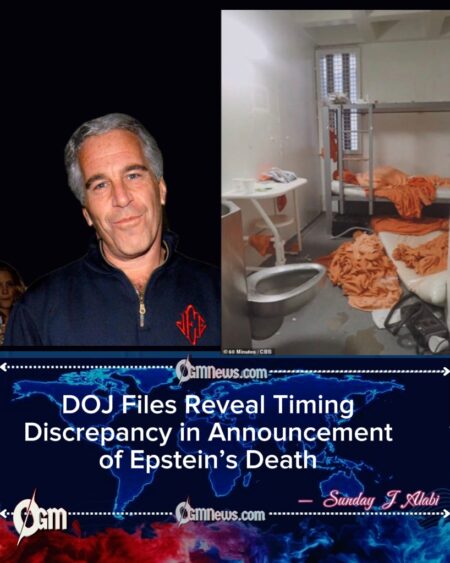
A federal statement announcing the death of financier and accused sex trafficker Jeffrey Epstein has resurfaced in newly released Justice Department files, drawing renewed attention to the unresolved questions surrounding his final hours. The document, dated August 9, 2019, appears to predate the moment Epstein was officially found unresponsive in his New York jail cell the following morning, according to prison records and prior official accounts.
While authorities have long maintained that Epstein died by suicide on August 10, 2019, the timing discrepancy highlighted by the statement has prompted fresh scrutiny of the administrative processes and systemic failures that marked one of the most consequential deaths in federal custody in recent history.
The Emergence of the Dated Federal Statement
The statement was issued by the United States Attorney’s Office for the Southern District of New York and bears the date Friday, August 9, 2019. In it, then–U.S. Attorney Geoffrey S. Berman said Epstein had been found unresponsive and pronounced dead earlier that morning, language that appears inconsistent with the established timeline.
According to official records, Epstein was not discovered unresponsive until shortly after 6:30 a.m. on August 10, when a corrections officer delivering breakfast found him in his cell at the Metropolitan Correctional Center (MCC) in Manhattan. Medical personnel were summoned and attempted resuscitation before he was pronounced dead.
The discrepancy has not been publicly explained by federal authorities, and there has been no indication that the date on the statement altered the official determination of events. Nonetheless, its reappearance has reignited debate about record-keeping and communication failures in the aftermath of Epstein’s death.
Epstein’s Detention and Pending Charges
Epstein, 66, had been held at MCC since his arrest on July 6, 2019. Federal prosecutors charged him with sex trafficking of minors and conspiracy, alleging that he operated a long-running scheme involving underage girls across multiple jurisdictions.
He pleaded not guilty and was awaiting trial at the time of his death. The charges exposed him to the possibility of decades in federal prison if convicted, marking a dramatic escalation from a controversial 2008 Florida plea agreement that had previously shielded him from federal prosecution.
His detention placed him at the center of intense public and legal scrutiny, with victims, advocates, and lawmakers closely watching the progress of the case.
Official Account of the Final Hours
Authorities have consistently stated that Epstein was discovered unresponsive in his cell shortly after 6:30 a.m. on August 10, 2019. Despite emergency medical efforts, he was pronounced dead soon afterward.
The New York City medical examiner later ruled the death a suicide by hanging. However, officials acknowledged that the precise time of death could not be definitively established due to gaps in monitoring and surveillance.
Those gaps would later become central to investigations into the operations of the facility on the night Epstein died.
Failures in Monitoring and Surveillance
Subsequent reviews found significant lapses in required inmate monitoring. Prison records showed that guards assigned to check on Epstein did not conduct mandatory rounds during the overnight hours before his body was discovered, missing scheduled checks at approximately 3 a.m. and 5 a.m.
In addition, surveillance cameras positioned outside Epstein’s cell were not functioning properly that night. Investigators confirmed that at least two cameras malfunctioned, leaving critical blind spots in an area housing one of the most high-profile detainees in federal custody.
Because of these failures, investigators were unable to reconstruct a complete timeline of Epstein’s final moments, a limitation that continues to fuel questions about the circumstances of his death.
Newly Released Files and Unresolved Observations
The newly released DOJ files include details reviewed by investigators in the aftermath of Epstein’s death, including limited surveillance observations from within the facility. According to the records, investigators noted footage showing what appeared to be an unidentified figure moving toward the floor where Epstein was housed during overnight hours.
The footage reportedly showed an orange-colored shape ascending a staircase near Epstein’s housing unit around 10:40 p.m. on the night before he was found dead. Investigators documented the movement but did not conclude that it had a direct connection to Epstein or his death.
Surveillance limitations and equipment malfunctions prevented a definitive assessment of activity in the unit, leaving the observation noted but unresolved in official findings.
Legal and Institutional Aftermath
Epstein’s death abruptly ended one of the most closely watched federal criminal cases in years. For many victims, it represented the loss of an opportunity to see the accused face trial and potential conviction in court.
While the criminal case against Epstein was closed, federal authorities stated that investigations into potential co-conspirators could continue. Civil litigation by victims has also proceeded, shedding light on broader networks and institutional responses.
The resurfaced statement, though not altering the official cause of death, underscores the lingering concerns about transparency, accountability, and procedural integrity within the federal detention system.


