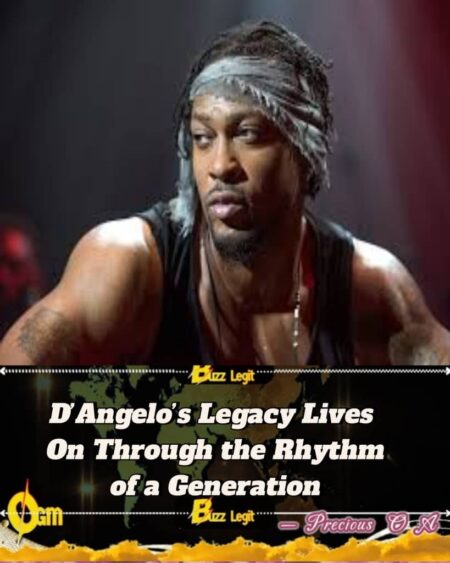
D’Angelo has died at the age of 51 after a courageous battle with pancreatic cancer, his former manager confirmed Tuesday evening. The acclaimed neo-soul artist passed away surrounded by close family members, leaving behind a rich musical legacy that redefined contemporary R&B and soul. His death has sent shockwaves throughout the music industry, marking the end of an era that he helped define with his distinctive sound and uncompromising artistry. Tributes poured in from around the world as fans, fellow musicians, and public figures paid homage to one of the most influential artists of his generation.
D’Angelo rose to prominence in the mid-1990s as one of the pioneers of the neo-soul movement. With his debut album Brown Sugar in 1995, he revitalized the sound of classic soul, blending it seamlessly with funk, gospel, and hip-hop influences. The album’s title track and “Lady” became instant classics, earning him critical acclaim and a loyal fan base. His effortless musicianship, coupled with raw lyrical honesty, resonated deeply with listeners who had longed for a return to authentic soul music in an era dominated by glossy pop and R&B formulas.
D’Angelo became a cultural icon whose smooth voice and soulful depth inspired a generation of musicians, including Alicia Keys, Maxwell, and John Legend. Fans and artists alike flooded social media with tributes, praising his artistry and authenticity. “He made us feel every word,” said H.E.R. in an emotional post. Even the younger generation of artists who never worked directly with him cited his music as a guiding light. His songs were not just performances; they were confessions wrapped in rhythm, filled with both pain and beauty.
The singer maintained a quiet presence in the years that followed his initial success, choosing introspection over celebrity. Despite his absence from the public eye, his influence continued to shape the sound of modern R&B. His refusal to compromise artistry for fame earned him the reputation of a true musical purist. He avoided the trappings of stardom, preferring the sanctuary of his studio to the chaos of red carpets and interviews. His decision to step away only deepened his mystique, making every rare public appearance or musical release an event of cultural significance.
D’ANGELO: THE MAKING OF A MUSICAL MYSTIC
D’Angelo re-emerged in 2000 with Voodoo, an album that is widely regarded as a masterpiece. The record earned him two Grammy Awards, including Best R&B Album, and solidified his position as a visionary artist. Songs like Untitled (How Does It Feel) and Devil’s Pie showcased his signature blend of sensuality and social consciousness. The album’s raw and live instrumentation stood out at a time when most mainstream music was heavily synthesized, proving that soul still had a place in modern music. Critics compared Voodoo to works by Prince and Marvin Gaye, calling it “a work of spiritual depth and human vulnerability.”
The artist struggled with fame and personal challenges in the years following Voodoo. Friends described him as deeply spiritual, sensitive, and devoted to his craft. He often spoke about the pressures of public life and his desire to remain true to the soul of his music. “Music saved me,” he once said, “but it also revealed everything I was running from.” Behind the stage persona was a man searching for peace — one who battled personal demons, addiction, and the burden of expectations that came with being labeled a musical genius.
D’Angelo took a long hiatus from the music scene, disappearing for nearly 14 years before his triumphant return in 2014 with Black Messiah. The album was hailed as both timely and timeless, addressing racial injustice, love, and faith. Critics celebrated it as one of the most important albums of the decade, a reminder that soul music still had something urgent to say. Released during a time of national unrest in America, Black Messiah became a soundtrack for social consciousness, bridging protest and poetry in equal measure.
The musician continued to write and record quietly even while battling illness. According to his former manager, he had been working on new music from his home studio until his health declined. “He never stopped creating,” the manager said. “Even when his body weakened, his passion for music never did.” Sources close to him said he was experimenting with new sounds that blended gospel, funk, and electronic influences. His perfectionism often led him to spend months fine-tuning a single track, a habit that defined his career from start to finish.
D’ANGELO: LEGACY OF A SOUL REVOLUTIONARY
D’Angelo leaves behind a legacy that transcends generations. His work helped shape the direction of modern R&B, merging old-school soul sensibilities with modern experimentation. His artistry bridged the gap between Marvin Gaye’s emotional honesty and Prince’s fearless innovation. Beyond his music, he inspired a new consciousness in Black artistry — one that celebrated vulnerability, spirituality, and resistance in equal measure.
The legendary performer influenced countless artists who cite him as a spiritual and musical mentor. Frank Ocean, Anderson .Paak, and Miguel have all credited him as a major inspiration. His sound — deeply emotional yet rhythmically daring — continues to echo in today’s music. His approach to songwriting, production, and live performance inspired a wave of musicians who embraced authenticity over commercialism. In his quiet rebellion, he taught artists that staying true to one’s craft was its own kind of revolution.
D’Angelo will be honored in a series of tribute concerts planned in New York, Los Angeles, and London. The Recording Academy described him as “a transformative artist whose impact will echo through generations.” Music historians agree that few artists embodied soul as truthfully as he did. Plans are also underway for a documentary chronicling his life and artistry, exploring his creative process, personal battles, and enduring influence on music.
D’Angelo will be remembered not just for his songs, but for the movement he created — one that celebrated vulnerability, faith, and freedom through music. His former manager summed up his life in a final tribute: “He sang about love, loss, and redemption — and made us believe every note. His soul lives on in the music he gave the world.” Fans continue to gather outside recording studios and concert halls where he once performed, leaving flowers, candles, and handwritten notes in remembrance of a man whose voice became the heartbeat of an entire generation.