










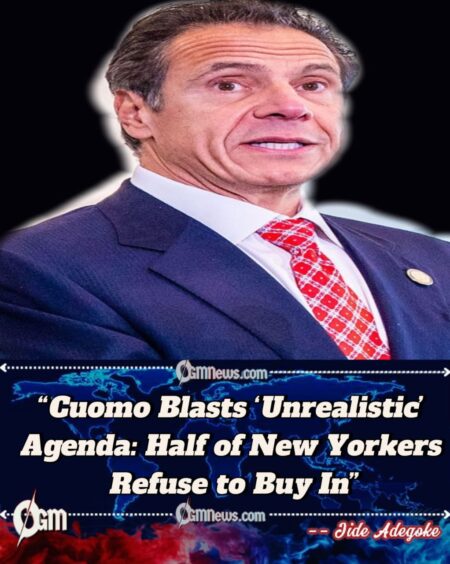
Former New York Governor Andrew Cuomo has voiced sharp criticism of what he described as an increasingly unrealistic government agenda in Albany. Speaking at a civic policy forum in Manhattan on Tuesday, Cuomo stated, “Almost half of New Yorkers did not vote to support a government agenda that makes promises that we know cannot be met.”
Cuomo’s remarks come amid growing public debate about the feasibility of the state’s ambitious social and economic policies, including expanded welfare programs, infrastructure spending, and new housing mandates. He cautioned that overpromising and underdelivering could further erode public trust in government institutions.
“The issue isn’t about ideology,” Cuomo said. “It’s about credibility. When government loses credibility by making promises that can’t be fulfilled, it breeds frustration, cynicism, and division.” His statement has sparked renewed discussion about whether New York’s current leadership can balance progressive ambitions with fiscal reality.
Half of New Yorkers Did Not Vote for a Government Agenda Built on “Unmet Promises”
Cuomo’s observation that nearly half of New Yorkers withheld support from the current administration has reignited focus on voter discontent and polarization in the state. Official data from recent elections indicates that voter turnout remains uneven across key demographics, with urban centers leaning toward the ruling party’s policies while suburban and upstate communities express increasing skepticism.
Analysts suggest that Cuomo’s remarks reflect a broader sentiment among moderate voters who feel alienated by what they perceive as excessive government spending and lofty commitments. Political scientist Dr. Evelyn Marks of Columbia University noted, “This is a clear warning shot. When nearly half of voters don’t buy into the policy vision, it signals a growing disconnect between government rhetoric and the electorate’s lived experience.”
Many New Yorkers have voiced concerns over economic strain, including rising taxes, slow infrastructure progress, and unfulfilled job creation promises. Cuomo’s warning underscores the challenge facing policymakers: to bridge political divides without making commitments that exceed fiscal capacity or administrative feasibility.
Cuomo Calls for Pragmatism and Honest Governance
In his closing remarks, Cuomo urged political leaders to ground their policies in practicality rather than populist appeal. “The public deserves honesty,” he said. “If a goal is unachievable within our current budget or capacity, leaders must say so. Transparency doesn’t weaken leadership—it strengthens it.”
He further warned that if the state continues to pursue expansive initiatives without clear financial pathways, it risks deepening economic instability. While Cuomo stopped short of directly criticizing current officials, his message was widely interpreted as a rebuke of both state and federal leaders—particularly amid economic uncertainty and shifting political alignments nationwide.
Observers note that Cuomo’s comments also carry national implications, as states across the U.S. face similar pressures to deliver on promises related to infrastructure, social welfare, and education amid tightening budgets. With President Trump currently serving his second term, federal-state relations over fiscal management remain a key point of contention.


