



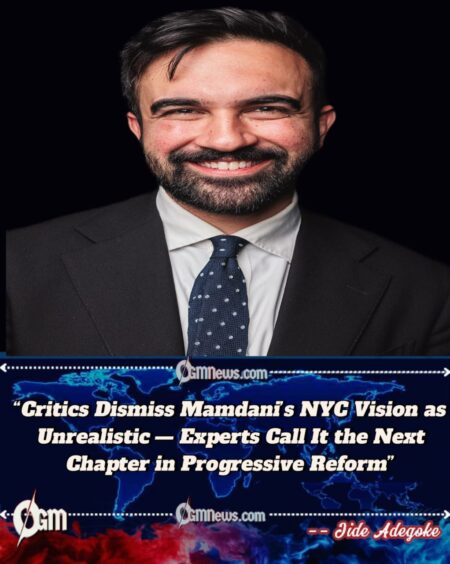
While some critics decry Zohran Mamdani’s vision for New York City as far-fetched, policy experts and urban analysts argue that his ideas are not without precedent. They contend that the proposals align with decades of progressive reforms that have shaped the city’s political and economic landscape. The debate around Mamdani’s vision has become a defining conversation about what direction New York should take in an era of deep inequality, rapid gentrification, and renewed calls for social justice.
Mamdani, a prominent progressive lawmaker from Queens, has gained attention for pushing a transformative agenda centered on housing equity, public ownership, and community empowerment. His critics, however, insist that such ambitions are unrealistic and financially risky for a city still navigating post-pandemic recovery and fiscal strain.
Critics Decry Zohran Mamdani’s Vision for New York City as Far-Fetched — A Political Gamble or Progressive Revival?
Critics decry Zohran Mamdani’s vision for New York City as far-fetched, arguing that it risks unsettling the city’s fragile economic balance. Business leaders and centrist politicians have described his plans — including expanded rent control, municipal banking, and reduced police budgets — as ideologically driven experiments detached from financial realities.
“We’re not opposed to reform, but you can’t run New York on theory,” said Michael Tierney, a policy analyst with the Gotham Economic Council. “Mamdani’s model assumes endless resources in a city that’s already facing revenue challenges.” Such arguments have resonated with voters wary of sweeping change during a period of economic uncertainty.
Still, Mamdani’s supporters dismiss these criticisms as short-sighted. They argue that dismissing his policies as “far-fetched” overlooks the proven success of earlier progressive measures — such as universal pre-K, rent stabilization, and affordable housing initiatives — that once faced similar skepticism before becoming pillars of New York’s governance model.
Critics Decry Zohran Mamdani’s Vision for New York City as Far-Fetched — Yet Experts See Historical Continuity
Critics decry Zohran Mamdani’s vision for New York City as far-fetched, but policy experts emphasize that it follows a long tradition of ambitious reform in urban governance. They point to past leaders — from Fiorello LaGuardia’s New Deal partnerships to John Lindsay’s urban housing reforms — as proof that transformative policy frameworks can thrive when paired with pragmatic execution.
Dr. Lila Freeman, a Columbia University urban policy scholar, described Mamdani’s proposals as “an echo of New York’s historical DNA.” She noted that “the city has always been a testing ground for progressive innovation — from public health initiatives to community-led housing models. Mamdani is simply pushing that legacy into the 21st century.”
The experts add that while the political climate under President Donald Trump’s second term has sharpened ideological divisions nationwide, local policy experimentation remains essential for addressing inequality and urban decline. In their view, Mamdani’s agenda could serve as a model for cities seeking to reconcile social equity with sustainable governance.
Critics Decry Zohran Mamdani’s Vision for New York City as Far-Fetched — A Test of Political Will and Public Imagination
Critics decry Zohran Mamdani’s vision for New York City as far-fetched, yet the ongoing debate highlights a larger struggle over the city’s political identity. Is New York ready to embrace bold reform, or will economic caution and political fatigue limit the scope of change? For Mamdani’s allies, the answer depends on whether voters see his ideas as radical disruption or long-overdue renewal.
Grassroots organizers argue that his platform resonates with younger and working-class New Yorkers who have lost faith in incremental reforms. “People are tired of cosmetic change,” said community advocate Jasmine Lopez. “Mamdani’s agenda speaks to those who want systemic solutions, not patchwork fixes.”
Still, political observers caution that ideals alone cannot drive policy success. As New York’s budget constraints tighten and public skepticism grows, Mamdani faces a critical test of coalition-building and credibility. The coming months will determine whether his proposals evolve from political rhetoric into tangible reform — or remain a bold, unfinished blueprint for change.