








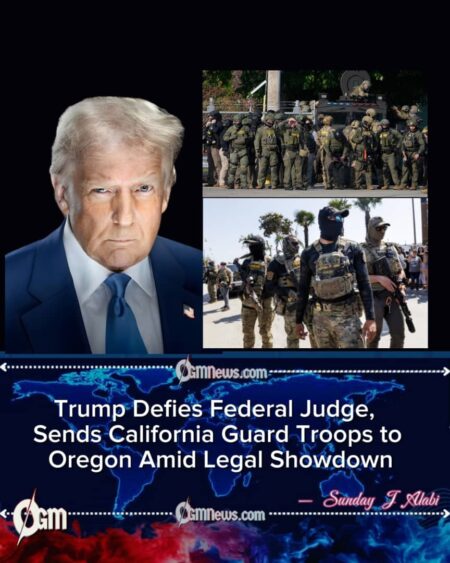
The legal and political standoff between the Trump administration and Democratic-led states intensified over the weekend as President Donald Trump ordered the deployment of federalized California National Guard troops to Oregon, despite a federal judge’s temporary restraining order blocking the move. The decision has sparked a constitutional dispute over state sovereignty, executive power, and the limits of federal intervention in local matters.
Federal Deployment Defies Court Order
Officials in California and Oregon confirmed that at least 200 members of the California National Guard were sent to Oregon overnight into Sunday, with more expected to arrive. The deployment, directed by President Trump, came less than 24 hours after U.S. District Judge Karin Immergut — appointed by Trump during his first term — temporarily barred the administration from sending the National Guard to Portland.
Judge Immergut ruled that the relatively small-scale protests in Portland did not justify the use of federalized forces and warned that such actions risked infringing on Oregon’s state sovereignty. The restraining order remains in effect until October 18.
Despite the injunction, Pentagon spokesperson Sean Parnell confirmed that federalized Guard members were reassigned to Portland to support U.S. Immigration and Customs Enforcement (ICE) and other federal personnel. White House Press Secretary Abigail Jackson defended the move, saying, “President Trump exercised his lawful authority to protect federal assets and personnel in Portland following violent riots and attacks on law enforcement.”
State Leaders Condemn “Breathtaking Abuse of Power”
California Governor Gavin Newsom sharply criticized the president’s decision, calling it “a breathtaking abuse of the law and power.” Newsom confirmed that 300 of California’s Guard troops had already been federalized for previous unrest in Los Angeles, but he accused the administration of “using the U.S. military as a political weapon against American citizens.”
Oregon Governor Tina Kotek also voiced outrage, saying that the deployment was a deliberate attempt to circumvent the court order. “There is no insurrection in Portland. There is no threat to national security. Oregon is our home, not a military target,” she said during a joint virtual news conference with Oregon Attorney General Dan Rayfield.
Rayfield and California Attorney General Rob Bonta jointly filed a second emergency motion to block the deployment, arguing that the states would suffer “irreparable harm” because the president’s order violated the Tenth Amendment, which reserves police powers to the states. “What was unlawful yesterday is unlawful today,” Rayfield declared. “The judge’s order was not a procedural hurdle for the president to sidestep.”
National Tensions Rise as Trump Expands Guard Deployments
The Oregon conflict comes amid a broader pattern of federal intervention by the Trump administration in Democratic-led states. Illinois Governor JB Pritzker revealed Sunday that 400 Texas National Guard members were being deployed to Illinois and Oregon, calling the move “Trump’s Invasion.”
Pritzker, who said he received no direct communication from federal officials, accused the president of undermining state authority. “It started with federal agents, it will soon include deploying federalized Guard members against our wishes,” he wrote on X, formerly Twitter.
President Trump, now serving his second term, has repeatedly characterized cities such as Portland and Chicago as “war zones,” insisting that federal action is necessary to restore law and order. Since the start of his term, he has ordered or discussed troop deployments in at least ten U.S. cities. The White House maintains that such actions are lawful and necessary to protect federal property and personnel.
However, legal experts warn that the president’s latest move could trigger a prolonged constitutional crisis over federal authority versus state autonomy — a battle that may ultimately reach the Supreme Court.