








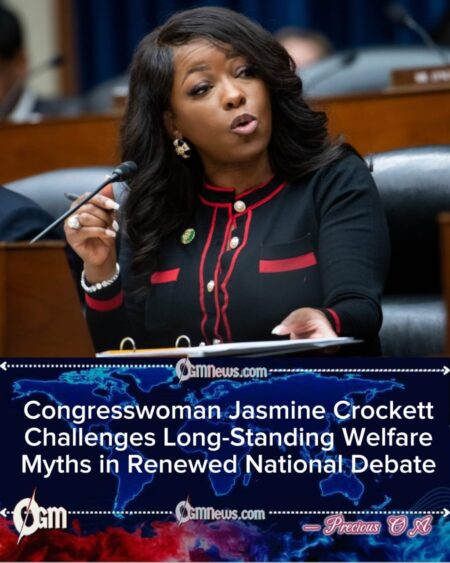
Congresswoman Jasmine Crockett highlighted the long-standing stereotype that welfare recipients are predominantly unmotivated individuals, often portrayed as Black women, and she emphasized that this deeply ingrained image has shaped generations of public discourse. She argued that this portrayal, which emerged from decades of political messaging and media framing, has been used to simplify complex social issues into racially charged caricatures that do not reflect the reality of economic hardship. Her remarks underscored that the narrative remains powerful precisely because it has been repeated so frequently and rarely questioned in mainstream conversations.
Jasmine Crockett emphasized that the narrative was intentionally crafted to influence political attitudes and redirect public scrutiny away from systemic inequality and toward vulnerable groups who lack the political power to defend themselves. She explained that this messaging framed low-income individuals as morally deficient rather than structurally disadvantaged, allowing policymakers to justify reductions in social spending. According to her, the harmful stereotype served as an effective tool to distract from policy decisions that benefitted more powerful economic interests.
Public policy researchers maintain that the persistence of these narratives has obstructed meaningful discussions about poverty, racial disparities, and the true composition of households receiving public assistance. They argue that the widespread reliance on inaccurate imagery reinforces stigma, discourages public empathy, and limits the willingness of lawmakers to expand or reform programs. Researchers further state that recalibrating the narrative is essential for producing fair and comprehensive policymaking that reflects genuine social needs.
Understanding the Scale of SNAP Assistance
Jasmine Crockett referenced updated federal data showing that more than 42 million Americans rely on the Supplemental Nutrition Assistance Program (SNAP), highlighting how deeply embedded the program is within the national safety net. She underscored the small size of the benefit, explaining that it averages roughly $6 per day—an amount insufficient for most households to purchase nutritious meals. Crockett stressed that the number reflects not extravagance but severe limitation, illustrating how minimal federal food assistance truly is when broken down to the cost of individual meals.
Economic analysts assert that the low value of SNAP benefits reflects longstanding budget constraints and political battles surrounding the program’s funding formulas. They argue that the program functions as a basic emergency measure rather than a comprehensive solution to food insecurity, especially as many families report running out of benefits before the end of each month. Analysts also note that variations in food costs across regions create even greater disparities in how far SNAP dollars stretch.
Advocates for low-income families contend that the limited support provided through SNAP undercuts the idea that welfare recipients are a major financial drain on government resources. They argue that the real issue lies in the insufficiency of the assistance itself, not in its cost, and they emphasize that increased funding could reduce hunger, improve health outcomes, and support children’s academic performance. These advocates also point out that SNAP dollars circulate directly into local economies, supporting grocery stores and food suppliers.
Corporate Subsidies and Federal Priorities
Jasmine Crockett drew significant attention when she contrasted the modest support provided to SNAP beneficiaries with the scale of federal incentives received by major corporations and influential business sectors. Her remarks highlighted the billions of dollars in grants, tax advantages, and research investments provided to industries such as aerospace, energy, and advanced technology innovation. She argued that these substantial government allocations receive far less criticism, despite dwarfing the financial support made available to individual households.
Government spending watchdog groups note that subsidies, tax incentives, and federal investment grants frequently exceed the total value of social assistance provided to millions of Americans. They argue that these programs, despite being labeled as economic development or national strategy, often lack sufficient transparency or accountability. Many watchdogs insist that the public rarely connects these subsidies to federal spending debates because corporate assistance is framed differently from welfare programs.
Economists acknowledge that federal investments in corporate innovation can stimulate long-term economic growth, create jobs, and contribute to national competitiveness in global markets. However, they also highlight the political tension created when substantial financial support exists alongside persistent public narratives portraying low-income citizens as burdens on the federal system. This contrast, they argue, raises important questions about the consistency and fairness of federal spending priorities.
Reaction From Policy Analysts and Advocacy Groups
Jasmine Crockett’s remarks prompted immediate responses from analysts who study poverty, government spending patterns, and political communication. Supporters of her position argue that challenging traditional welfare stereotypes is essential for achieving a more truthful and data-driven understanding of poverty. They believe her comments have opened an opportunity for a more honest debate about how public funds are allocated and why certain groups are framed negatively.
Critics of her comparison between social welfare and corporate subsidies argue that the two forms of spending serve fundamentally different purposes and cannot be equated without distortion. They maintain that corporate support is tied to national infrastructure, strategic innovation, and industrial growth, whereas welfare programs address immediate human needs. Some critics also warn that such comparisons may unintentionally undermine confidence in federal investment programs that drive technological progress.
Advocates for reform assert that public understanding of federal spending must be broadened, especially in a climate where misconceptions circulate widely through social media. They believe the debate sparked by Crockett’s remarks may encourage Americans to reassess long-standing assumptions about who benefits most from government actions. These advocates argue that reframing the conversation is necessary for creating policies that reflect real economic imbalances.
Public Discourse and Shifting Perspectives
Jasmine Crockett became a central figure in online discussions as her comments spread widely across social platforms, generating debate among voters, commentators, and activists. Many users expressed strong support for her efforts to dismantle racialized welfare stereotypes and highlight inconsistencies in federal financial priorities. Supporters praised her for speaking publicly about issues often minimized in legislative discussions.
Other commentators questioned whether comparing corporate subsidies to individual welfare oversimplifies complex budgetary systems or ignores the broader economic implications of federal investment. They argued that each category of spending should be analyzed independently, with attention to its specific goals, costs, and returns. Some insisted that public reactions often blur important distinctions, contributing to misunderstanding.
The expanding debate reflects a growing interest in accountability, transparency, and fairness within federal economic policy. Observers suggest that increased public engagement may influence future political debates and encourage lawmakers to confront widely held misconceptions. They note that as more people learn about the scale of both welfare programs and corporate subsidies, pressure may build to reassess national priorities.
Implications for Future Policy Debates
Jasmine Crockett’s comments may contribute to renewed scrutiny of federal funding priorities as lawmakers approach budget negotiations and long-term fiscal planning. Analysts believe her remarks could prompt congressional committees to examine whether public narratives about welfare recipients have distorted legislative decision-making. The discussion may also influence debates over how to measure the effectiveness and fairness of federal spending.
Policy experts anticipate that continued attention to these issues may spark broader conversations about economic opportunity, social safety nets, and the responsibilities of government toward both individuals and corporations. They highlight the need for clear, transparent data to guide policymaking and prevent long-standing stereotypes from dictating budget outcomes. These experts believe that debates like the one Crockett initiated are essential for building a more equitable system.
Shifts in public perception, combined with increased pressure from advocacy organizations, may eventually lead legislators to reevaluate how government support is distributed. Whether such reevaluations result in meaningful reforms will depend on political will, bipartisan cooperation, and the ability of policymakers to engage with complex economic realities rather than campaign rhetoric. Nonetheless, Jasmine Crockett’s remarks have established a foundation for continued debate.