










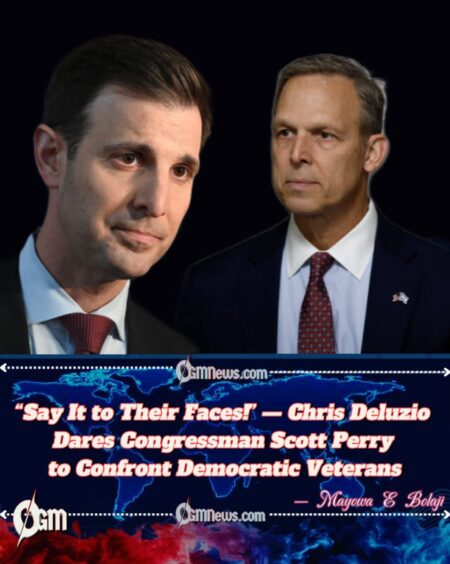
Congressman Scott Perry asserted that Democratic-party members join the military not primarily to serve the nation, but to build credentials that will help them run for political office. He claimed that some veterans who are Democrats leverage their uniform and service record as a springboard into electoral politics, rather than out of patriotic duty.
Perry further escalated his rhetoric by alleging that those same Democratic veterans “hate the military” and by questioning their loyalty and motives — language which many observers say casts millions of veterans in a disparaging light.
These remarks have sparked heated backlash, particularly among Democratic-veteran communities, who view the comments as an affront to their service and sacrifice. The contention now centres on not just motive, but respect for military service across party lines.
Veteran Democrat’s Sharp Response – Deluzio Speaks Out
Responding to Scott Perry’s remarks, Representative Deluzio (a veteran and Democratic member of Congress) described the allegations as “an unbelievable load of bullshit.” He challenged Perry to repeat his comments face-to-face with Democratic veterans in Perry’s own district, insisting that there are “thousands of them” whom Scott Perry is insulting from afar.
Deluzio also pointedly referenced Scott Perry’s involvement in the post-2020 election efforts to overturn results, saying: “I’m not interested in any lecture from someone like him who tried to overthrow our government after the 2020 election.” He said that if Perry truly believed his own statements, he should hold a town-hall and “say that to their faces.”
In so doing, Deluzio framed the argument as one of accountability and respect: veterans deserve acknowledgment of their service regardless of party, and accusations that frame them as cynical opportunists not only degrade individuals but risk undermining public trust in military service itself.
Wider Implications and Fallout for the Veteran Community
Scott Perry’s comments have prompted responses beyond this one exchange, with editorial boards and veteran organisations raising concern about the broader implications. For example, a local editorial board in Pennsylvania said Perry “has gone a step too far in defaming millions of veterans who just happen to be Democrats.”
The backlash raises questions about how political affiliation intersects with military identity — and whether partisan rhetoric risks alienating veterans who do not align neatly with one party. Democratic veterans’ caucuses have publicly stated that Scott Perry’s remarks show disrespect for those who served under both colours.
In the backdrop of these developments lies a larger narrative: The political recruitment of veterans by both parties, the evolving public perception of military service as credential versus calling, and the risk that polarised partisan statements could erode cross-party respect for service members. The controversy may also influence veteran engagement, party outreach strategies and the tone of political debate around military credentials and motives.


