








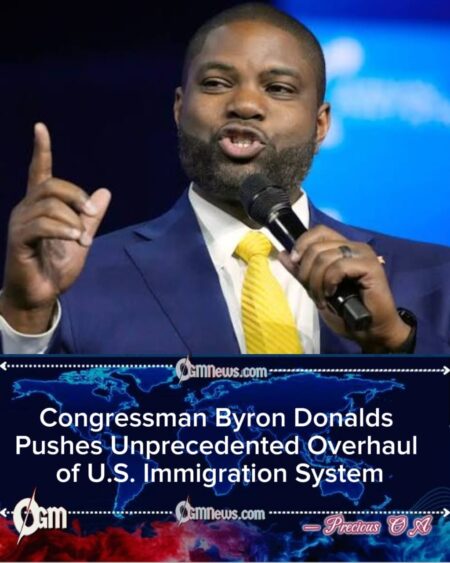
Congressman Byron Donalds, launching his high-stakes run for Florida governor, escalated his rhetoric by calling for the complete abolition of H-1B visas, a central pillar of the country’s high-skilled immigration system. In a sprawling and forceful address, he presented this policy shift as more than a campaign talking point, framing it instead as a fundamental restructuring of America’s employment priorities. His announcement was delivered with heightened urgency, designed to capture the attention of voters who feel increasingly uneasy about outsourcing, global competition, and domestic job security.
Byron Donalds argued that the current visa structure disadvantages American workers, framing his proposal as a necessary correction to longstanding federal policies. He asserted that the federal government has for too long permitted corporations to bypass American talent in favor of cheaper international labor, thereby weakening the country’s internal economic fabric. His declaration was delivered with a tone of conviction, intended to resonate with working-class Floridians who have expressed frustration about job displacement and wage stagnation in several key industries.
Campaign strategists noted that his position aligns with a broader nationalist trend within certain factions of the Republican Party, signaling a deliberate effort to consolidate support among voters wary of foreign labor programs. Analysts believe he is intentionally positioning himself as the candidate most willing to defy traditional business interests while appealing to voters who prioritize American competitiveness over global labor mobility. This calculated alignment may help define the landscape of the upcoming gubernatorial contest by forcing rivals to clarify their own positions on immigration-linked workforce issues.
IMMIGRATION AND ECONOMIC PRIORITIES
Byron Donalds insisted that abolishing the H-1B program would protect domestic job opportunities, particularly in Florida’s competitive science and technology sectors. He asserted that Floridians possess the capability and qualifications to fill the roles often awarded to foreign workers, arguing that the state’s economy should be re-engineered to prioritize local employment pipelines. His remarks underscored a deeper message: that the future of Florida’s innovation landscape must rest on American workers and educational institutions rather than international recruitment.
Byron Donalds emphasized that corporations should focus on hiring U.S. citizens rather than relying on what he described as “imported labor subsidies” that suppress wages. He claimed that multinational companies have become too dependent on global labor pools instead of investing in training American workers for essential technical roles. Throughout his commentary, Donalds positioned these concerns as part of a larger economic philosophy centered around national resilience, autonomy, and long-term economic sovereignty.
Economic analysts, however, observed that eliminating the visa category could significantly impact industries that depend on specialized foreign professionals, potentially prompting mixed reactions across the state. Experts noted that sectors such as software engineering, healthcare technology, and advanced manufacturing may face workforce shortages without access to highly trained international talent. This divergence in economic interpretations highlights the complexity of the issue and foreshadows a spirited public debate as the gubernatorial race progresses.
BIRTHRIGHT CITIZENSHIP CONTROVERSY
Byron Donalds reaffirmed his position against birthright citizenship, arguing that the Fourteenth Amendment has been misinterpreted and requires urgent legislative correction. He portrayed the existing system as a magnet for unlawful immigration, suggesting that automatic citizenship acts as a powerful incentive for illegal border crossings. His remarks delivered a sweeping critique of federal policy, emphasizing that reforms are crucial to preserving what he described as “constitutional integrity.”
Byron Donalds stated that ending automatic citizenship for children born to undocumented immigrants would help deter unlawful border crossings and strengthen national security. According to him, this change would reduce the strain on public resources and restore federal authority over citizenship eligibility. His tone throughout his remarks remained unyielding, designed to appeal to voters who are deeply concerned about porous borders and the long-term demographic implications of current immigration laws.
Legal scholars countered that altering birthright citizenship would face substantial constitutional challenges, raising questions about feasibility, federal authority, and judicial interpretation. Constitutional experts highlighted that the Fourteenth Amendment has been consistently upheld for generations, making any attempt to revise its modern application an extraordinarily difficult legal undertaking. This conflict between legal precedent and political advocacy adds additional tension to the unfolding debate.
NO PATHWAY FOR UNDOCUMENTED IMMIGRANTS
Byron Donalds declared that he opposes all pathways to citizenship for undocumented immigrants currently residing in the United States, describing legalization efforts as incentives for continued unlawful entry. His remarks were intended to demonstrate a firm commitment to immigration enforcement policies that prioritize deterrence over accommodation. Supporters described his position as refreshingly uncompromising in an era of political caution.
Byron Donalds warned that granting regularization or amnesty would undermine immigration enforcement and place additional strain on public services. He emphasized that states like Florida already face significant challenges related to healthcare access, school capacities, and local safety concerns, all of which could be worsened by expansive legalization efforts. His warnings were delivered with a consistent tone of urgency, reinforcing his central campaign message about restoring order and predictability to the immigration system.
Policy experts noted that such a stance, while popular among certain conservative constituencies, could alienate moderate voters and business leaders who rely on immigrant labor. They indicated that Florida’s agricultural, tourism, and construction sectors are deeply intertwined with immigrant workforces, making broad enforcement-only policies potentially disruptive to the state’s economic stability. This tension suggests that Donalds’ proposal may become one of the most divisive issues in the upcoming election cycle.
RESPONSE FROM POLITICAL OPPONENTS
Critics accused Donalds of adopting extreme positions that could destabilize Florida’s workforce and escalate tensions surrounding immigration reform. They argued that his proposals lack nuance and fail to account for the real-world complexities of modern economic systems. Many opponents warned that such sweeping policies could have profound and unpredictable consequences for Florida’s future.
Democratic leaders argued that his proposals would harm families, disrupt established communities, and contribute to widespread economic uncertainty. They contended that Donalds’ platform overlooks the humanitarian dimensions of immigration policy, focusing exclusively on enforcement without providing a framework for long-term stability. These critiques underscore the polarized partisan environment in which the gubernatorial campaign is unfolding.
Republican rivals, meanwhile, assessed how Donalds’ aggressive policy framing might shift the dynamics of the gubernatorial primary, particularly among undecided conservative voters. They acknowledged that his hardline stance appeals to a passionate segment of the party but questioned whether it could translate into statewide electoral success. This internal Republican tension is expected to shape the direction of campaign messaging as the primary season advances.
IMPLICATIONS FOR FLORIDA’S GOVERNORSHIP RACE
Political observers suggested that Donalds’ platform may energize a segment of the electorate that prioritizes strict immigration enforcement as a voting issue. They noted that his unflinching focus on reworking federal systems resonates with voters who feel alienated by traditional political messaging. His campaign is poised to capitalize on this energy as he continues to build his statewide coalition.
Byron Donalds continued to present himself as a candidate willing to take uncompromising positions on national security and labor protection, differentiating him from more moderate contenders. His relentless emphasis on sovereignty, border control, and economic protectionism is shaping his brand as one of the most assertive voices in the Florida race. His team believes this image will appeal to voters seeking a governor who prioritizes national strength and state-level independence.
Campaign analysts predicted that immigration policy would become a dominant issue in the Florida gubernatorial race, forcing all candidates to articulate sharper and more detailed positions as debates intensify. They expect the subject to overshadow many other policy areas due to its emotional weight, economic implications, and influence on voter turnout. As the campaign unfolds, Donalds’ bold proposals are likely to spark extensive discussion, controversy, and continued national attention.