






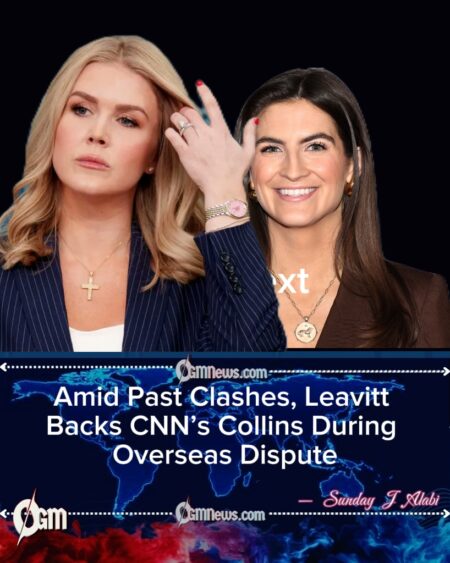
CNN anchor Kaitlan Collins has revealed a striking moment of professional solidarity involving White House Press Secretary Karoline Leavitt during a recent U.S. press delegation trip to Saudi Arabia. Despite a history of pointed exchanges inside the White House briefing room, Collins said Leavitt intervened on her behalf after Saudi officials attempted to bar her from a subsequent press event following a tense exchange with President Donald Trump, who is currently serving his second term as U.S. president.
Collins described the incident on the Absolutely Not Podcast, characterizing the episode as both unexpected and meaningful. The moment, she said, underscored the complexities of professional rivalries and the importance of unity among American officials and journalists when operating abroad.
A Tense Exchange in Riyadh
According to Collins, the incident occurred during a press conference in Saudi Arabia attended by President Trump and Crown Prince Mohammed bin Salman. During the event, Collins said she shouted a question to the president, which went unanswered.
Following the engagement, Collins recounted that members of the Saudi Royal Guard reacted strongly to her attempt to pose a question. She explained that officials appeared unaccustomed to such exchanges, noting that Saudi Arabia does not operate under the same traditions of press freedom as the United States.
Shortly afterward, Collins said she was informed that she would not be permitted to attend a subsequent press event due to her earlier actions. The development came as a surprise, particularly given her accreditation as part of the official U.S. press contingent traveling with the president.
An Unanticipated Intervention
Collins said the situation de-escalated when White House staff became aware of the confrontation and approached Press Secretary Karoline Leavitt. Despite the pair’s well-documented history of contentious exchanges, Collins recalled that Leavitt firmly told officials she would be entering the event with the rest of the American press corps.
“To her credit, she said: ‘No, Kaitlan is coming in with the rest of the U.S. press,’” Collins recounted on the podcast. The intervention resolved the issue, allowing her to participate in the scheduled coverage.
Collins later reflected that such unity is particularly important when representing the United States abroad. She emphasized the distinction between American press norms and those of countries where press freedoms are more restricted, suggesting that maintaining cohesion among U.S. officials and journalists can be critical in sensitive diplomatic environments.
A History of Heated Exchanges between Collins and Leavitt
The private moment stands in contrast to the public confrontations that have frequently defined interactions between Collins and Leavitt. Inside the White House press briefing room, the two have often engaged in sharp exchanges over economic policy, national security, and presidential authority.
In December, Kaitlan questioned Leavitt regarding the president’s economic record and inflation trends. The exchange intensified when Leavitt accused segments of the media of scrutinizing President Trump’s record more aggressively than that of President Joe Biden during his administration.
Similarly, in November, Collins challenged Leavitt’s characterization of a video involving Democratic lawmakers discussing the refusal of unlawful military orders. The dispute ended with visible frustration among members of the press corps.
Disputes Over National Guard Deployment
Another notable clash occurred in October when Collins pressed Leavitt over President Trump’s threatened deployment of the National Guard to Portland following unrest in the city. A federal judge—appointed during President Trump’s first term—had temporarily blocked the deployment, ruling that the action was not sufficiently tied to conditions on the ground.
Collins questioned whether local officials in Portland had requested federal intervention. Leavitt responded by defending the administration’s legal position and expressing confidence that the president’s authority would ultimately be upheld on appeal.
The exchange reflected broader debates over executive authority and federal-state relations, themes that have frequently surfaced during the president’s second term.
Professional Rivalry and Institutional Norms
The Saudi Arabia episode illustrates how professional rivalry within the press briefing room can coexist with institutional cooperation when American representatives operate overseas. Collins described the experience as a reminder that, regardless of policy disagreements or pointed questioning, shared principles surrounding press access remain significant.
For observers of White House dynamics, the incident provides insight into the complex relationship between reporters and administration officials—one defined by scrutiny and accountability, but also by moments of procedural consensus.
While public disagreements between Collins and Leavitt have often drawn attention, the Riyadh intervention suggests that professional boundaries and shared expectations regarding the American press may prevail in high-stakes diplomatic contexts.