








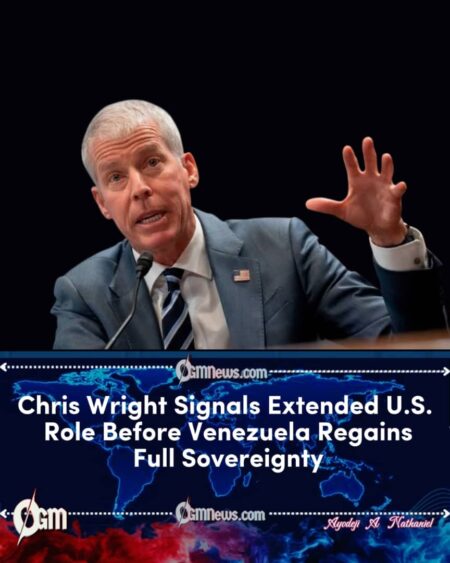
Chris Wright, the U.S. Energy Secretary, has outlined a broad and potentially lengthy transition period for Venezuela under U.S. involvement, signaling that restoring full sovereignty will depend on the establishment of what Washington considers a representative and legitimate government. His remarks frame the administration’s approach as deliberate, conditional, and tied closely to political reform and energy-sector stabilization.
Speaking on the policy outlook, Chris Wright emphasized that the current authorities in Caracas lack democratic legitimacy in the eyes of the United States, making an immediate handover of control unlikely. The transition, he said, could take one to two years—or longer—depending on conditions on the ground.
Chris Wright Sets the Tone for a Measured Transition
At the core of the administration’s position is the belief that Venezuela’s political crisis cannot be resolved quickly. Chris Wright argued that rebuilding institutions, restoring investor confidence, and stabilizing oil production require time and external oversight before power can be fully returned to Venezuelan hands.
U.S. officials say this approach is intended to prevent a power vacuum or economic collapse, both of which could deepen regional instability. The transition timeline, they argue, is a safeguard rather than an occupation.
Energy Policy and the Role of Chris Wright
Energy considerations are central to the U.S. strategy, and Wright has been explicit that oil revenues are seen as a tool for recovery and leverage. By supervising the flow and management of Venezuelan oil exports during the transition, the administration believes it can help fund reconstruction while discouraging corruption.
This strategy, according to Wright, is designed to ensure that oil wealth benefits ordinary Venezuelans in the long term, rather than entrenching political elites or criminal networks.
Chris Wright on Legitimacy and Sovereignty
In addressing sovereignty concerns, Wright stressed that U.S. involvement is conditional and temporary. He stated that full sovereignty would be restored only after credible political institutions are in place and recognized as legitimate by the international community.
The emphasis on legitimacy reflects Washington’s broader stance that democratic governance is a prerequisite for lasting stability, even if achieving it requires prolonged external engagement.
The White House Perspective on Venezuela
The policy outlined by Chris Wright aligns with the broader foreign policy direction of Donald Trump, the current U.S. president serving a second term. The administration has framed its actions as part of a hemispheric strategy that links energy security, anti-corruption efforts, and democratic norms.
Officials close to the White House argue that a stable and legitimate Venezuela could eventually contribute to lower global energy prices and improved regional security.
Regional and International Reactions
Reactions across Latin America and beyond have been mixed. Some governments have cautiously welcomed efforts aimed at democratic transition, while others have expressed concern over the precedent of extended foreign oversight of a sovereign state.
International observers note that the success of the plan will depend not only on timelines, but also on transparency, legal frameworks, and cooperation with multilateral institutions.
What Comes Next for Venezuela
As the transition unfolds, benchmarks such as electoral reforms, institutional rebuilding, and economic recovery will likely determine its duration. U.S. officials insist there is no fixed end date, only conditions that must be met.
For now, the remarks signal that Washington is preparing for a long-term role, with energy policy and governance reform tightly intertwined.