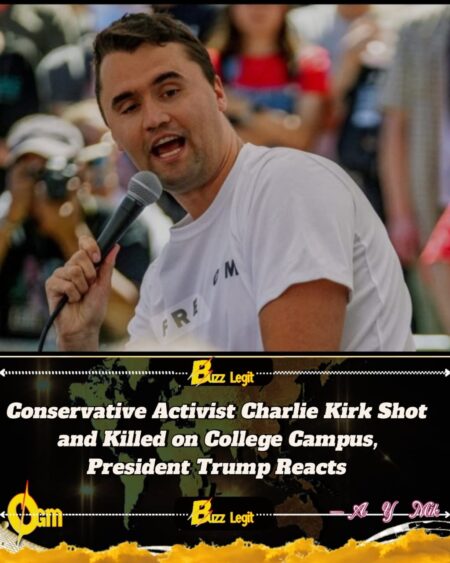
Conservative activist Charlie Kirk has died after being shot in the neck during a student event at Utah Valley University (UVU) in Orem, Utah, on Wednesday. President Donald Trump confirmed the death on his Truth Social platform, calling Charlie Kirk “a great guy from top to bottom” and urging Americans to pray for his family.
The shooting unfolded around 1 PM local time while Charlie Kirk was addressing students at a Q&A session that drew hundreds, including supporters and vocal protesters. Disturbing footage circulating online appears to show Charlie Kirk collapsing after being struck by a single bullet to the neck. Witnesses reported chaos in the auditorium as students screamed and rushed for safety.
University officials initially released a statement suggesting that the shot had been fired from the top of a nearby building roughly 200 yards away. “To the best of our knowledge, he has been hit and a suspect is in custody,” the statement read. However, within hours, that claim was walked back. A UVU spokesperson later clarified that the suspect initially questioned was not under arrest and had been released pending further investigation.
The shifting narrative has fueled confusion and anger among students, parents, and members of the broader community, with many demanding greater transparency from campus officials. As of late Wednesday evening, local police had not identified a definitive suspect, though security measures around the university remained heightened.
National Reaction: Tributes, Controversy, and Calls for Unity
Charlie Kirk’s death sparked immediate reactions across the political spectrum, with many conservatives mourning the loss of a figure they considered pivotal in shaping youth engagement in right-wing politics. Turning Point USA, the organization he cofounded at just 18 years old, issued a brief statement describing him as “a fearless leader who believed in empowering the next generation of conservatives.”
President Trump’s response highlighted Charlie Kirk’s closeness to his political movement. In his message, the President not only mourned Kirk’s passing but also described him as “a true patriot who never stopped fighting for America.” Other high-profile conservatives, including members of Congress, echoed the sentiment, praising Kirk’s energy and commitment to advancing conservative ideas on college campuses.
Still, Charlie Kirk’s polarizing presence ensured that reactions were far from unanimous. Critics recalled his prominent role in amplifying misinformation about the 2020 election, as well as his links to the January 6 rally in Washington, D.C., where Turning Point USA sponsored buses to transport attendees. Kirk invoked his Fifth Amendment rights during a congressional inquiry but acknowledged that his organization had turned over thousands of documents.
For many observers, Kirk’s death underscores the increasingly hostile climate surrounding campus political events. Several commentators urged universities nationwide to reassess security procedures, warning that rising political polarization and widespread availability of firearms could make such tragedies more frequent.
Legacy of a Divisive Figure in Conservative Politics
Charlie Kirk rose to national prominence when he founded Turning Point USA in 2012. His grassroots campaign to bring conservative activism to high school and college campuses grew rapidly, turning him into a media fixture and a regular presence at Republican events. Known for fiery exchanges with liberal students and for viral social media content, Kirk cultivated both passionate supporters and determined detractors.
Under his leadership, Turning Point USA established itself as one of the most influential youth conservative organizations in America, hosting annual student summits that attracted thousands. His critics often accused him of stoking division and using combative rhetoric, while supporters praised him for challenging what they described as “left-wing orthodoxy” on college campuses.
Beyond activism, Charlie Kirk also became a prominent media personality, hosting podcasts, speaking on television, and engaging millions of followers on platforms such as X. His relentless messaging—particularly after the 2020 election—made him one of the most visible voices among younger conservatives.
While his sudden death leaves many unanswered questions, it also cements his status as one of the most polarizing figures of his generation. Whether remembered as a trailblazer for conservative youth or as a lightning rod for controversy, Kirk’s influence on American political culture will not be easily forgotten.