










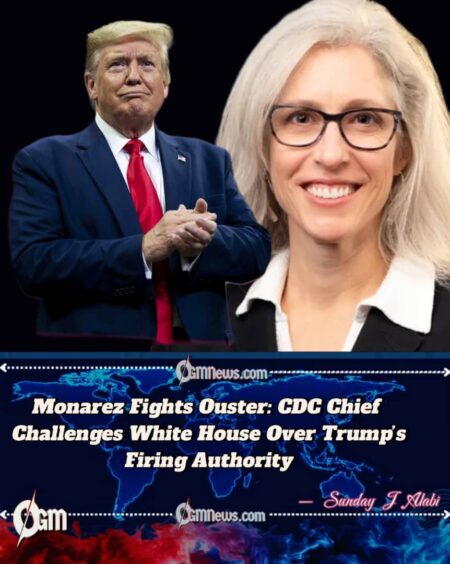
The Centers for Disease Control (CDC) and Prevention is in crisis after Director Susan Monarez was removed from her position Wednesday, sparking a legal dispute over whether only President Trump has the authority to fire her. The Department of Health and Human Services announced Monarez’s departure via social media, but her attorneys immediately contested the move, arguing she remains legally in charge of the nation’s premier public health agency.
The controversy erupts as multiple senior CDC officials resigned in protest over what they describe as the “weaponization of public health” under the Trump administration. The departures highlight growing tensions between career public health experts and political appointees over vaccine policy, budget cuts, and scientific independence at the agency responsible for protecting American health.
Legal Dispute Over Firing Authority Escalates
Monarez’s legal team, led by prominent D.C. attorneys Mark Zaid and Abbe Lowell, maintains that their client “has neither resigned nor received notification from the White House that she was fired.” They argue that as a presidential appointee confirmed by the Senate, only President Trump himself possesses the constitutional authority to terminate her position, making her removal by White House personnel staff “legally deficient.”
The attorneys allege Monarez was “targeted” for refusing to “rubber-stamp unscientific, reckless directives and fire dedicated public health experts.” White House spokesman Kush Desai countered that Monarez was terminated for refusing to resign despite allegedly informing HHS leadership of her intent to step down. The conflicting narratives underscore the broader ideological clash between the administration’s health policies and traditional public health approaches.
According to Zaid and Lowell, Monarez was notified of her firing Wednesday night by a White House personnel office staffer rather than the president directly. This procedural detail forms the crux of their legal challenge, as they contend the method of termination violates established protocols for removing Senate-confirmed officials.
Mass Exodus of Senior CDC Leadership
The Monarez controversy coincides with an unprecedented wave of resignations among top CDC officials, with at least three senior leaders departing Wednesday alone. Daniel Jernigan, director of the National Center for Emerging and Zoonotic Infectious Diseases, cited “the current context in the Department” as his reason for leaving, while Chief Medical Officer Debra Houry and National Center for Immunization and Respiratory Diseases head Demetre Daskalakis also announced their exits.
Houry, a decade-long CDC veteran, warned colleagues about the “rise of misinformation” regarding vaccines and expressed concern that planned budget cuts would undermine the agency’s mission. In her farewell message, she emphasized that “science at CDC should never be censored or subject to political pauses or interpretations,” declaring vaccines an “indisputable, well-established, scientific fact.”
Daskalakis delivered perhaps the most scathing critique, stating he could no longer serve due to the “ongoing weaponizing of public health.” He accused Kennedy and his staff of practicing “radical non-transparency” and “unskilled manipulation of data to achieve a political end rather than the good of the American people,” marking an extraordinary public rebuke from a career public health official.
Kennedy’s Controversial Health Agenda Under Fire
Health and Human Services Secretary Robert F. Kennedy Jr.’s vaccine skepticism appears central to the current turmoil at CDC. The longtime vaccine critic has systematically dismantled traditional vaccine oversight mechanisms, firing all members of the independent CDC panel responsible for vaccine recommendations and halting contracts for mRNA vaccine research earlier this month.
Kennedy’s influence has manifested in significant policy changes, including the Food and Drug Administration’s Wednesday decision to approve updated COVID-19 vaccines only for seniors and high-risk individuals, excluding healthy adults and children from eligibility. These moves have alarmed infectious disease experts who view them as departures from established scientific consensus on vaccine safety and efficacy.
The friction between Monarez and Kennedy reportedly centered on COVID-19 vaccines and the CDC’s advisory panel operations. CDC officials revealed that the Trump administration disapproved of Monarez’s public statements supporting vaccines and prevented her from publishing an opinion piece about the August shooting at CDC headquarters by a gunman upset about COVID-19 vaccines.
Political Fallout and Congressional Response
Democratic Senator Patty Murray of Washington, a member of the Senate health committee, responded to Monarez’s ouster by demanding Kennedy’s removal, calling him “a dangerous man who is determined to abuse his authority to act on truly terrifying conspiracy theories and disinformation.” Murray’s statement reflects broader Democratic concerns about the administration’s approach to public health policy.
The political ramifications extend beyond partisan criticism, as Monarez’s confirmation process earlier this year highlighted Republican concerns about vaccine policy leadership. She replaced President Trump’s initial CDC director nominee, former Florida Representative Dave Weldon, after Republican senators expressed reservations about his familiarity with CDC operations and his history of vaccine skepticism.
Monarez’s confirmation in July followed a party-line Senate vote, with Democrats supporting her nomination based on her scientific credentials and commitment to vaccine programs. During confirmation hearings, she explicitly rejected Kennedy’s discredited theories linking childhood vaccines to autism, stating she had “not seen a causal link between vaccines and autism” and promising to “prioritize vaccine availability.”
Agency Under Siege: Budget Cuts and Security Concerns
The current leadership crisis compounds existing challenges facing the CDC, including significant budget cuts that resulted in hundreds of layoffs this year. Staff morale has been further impacted by the August shooting incident outside the Atlanta headquarters, which highlighted growing hostility toward public health officials in the post-pandemic era.
The combination of personnel upheaval, budget constraints, and political pressure has created what former officials describe as an unprecedented crisis for an agency traditionally insulated from partisan politics. The CDC’s mission to protect public health through scientific research and evidence-based recommendations faces fundamental challenges under the current administration’s approach to health policy.
Monarez’s background includes a Ph.D. in microbiology and immunology, though she differs from most previous CDC directors in lacking a medical degree. Her career spanned multiple administrations, including roles in the Obama White House’s science and technology office, the Department of Homeland Security during Trump’s first term, and deputy director of the Advanced Research Projects Agency for Health.
Uncertain Future for Public Health Leadership over Monarez dismissal authority
The legal battle over Monarez’s firing authority could establish important precedents for executive power over Senate-confirmed appointees. Constitutional experts will likely scrutinize whether established removal procedures were properly followed and whether career public health officials can effectively challenge politically motivated terminations.
The broader implications for CDC operations remain unclear as the agency navigates leadership uncertainty during ongoing public health challenges. The departure of experienced officials versed in infectious disease response, vaccine policy, and emergency preparedness could impact the agency’s ability to respond to future health crises.
President Trump’s nomination of Monarez in March emphasized his goal to restore public confidence in the CDC after what he termed “political bias and disastrous mismanagement.” However, the current controversy suggests that tensions between political appointees and career public health officials continue to challenge the agency’s traditional role as an independent scientific institution focused on protecting American health.


