










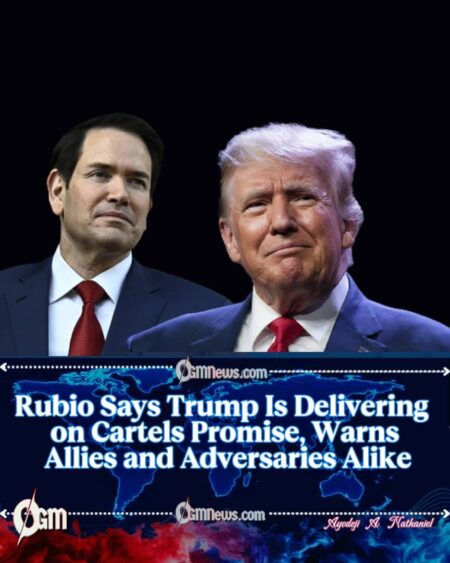
Senator Marco Rubio delivered an emphatic defense of President Donald Trump on national security, declaring that the administration is doing exactly what it promised by confronting drug cartels and transnational criminal networks. Rubio dismissed public surprise at recent actions, arguing that Trump’s approach has been consistent and explicit since his campaign.
According to Rubio, the current push against cartels and affiliated organizations reflects a broader doctrine centered on deterrence, enforcement, and accountability. He framed the moment as a test of whether political leaders will take stated commitments seriously when they are translated into policy.
“He Said It — and He Does It”
Rubio’s remarks focused heavily on what he described as Trump’s defining political trait: follow-through. He argued that voters elected Trump precisely because he does not retreat from stated positions once in office.
In Rubio’s telling, criticism and shock from opponents stem not from unpredictability, but from disbelief that a president would act decisively on campaign promises. He stressed that Trump’s actions against cartels are not abrupt deviations, but long-signaled policy choices now being implemented.
Targeting Cartels as National Security Threats
The senator emphasized that drug cartels should be viewed not merely as criminal enterprises, but as national security threats. He linked cartel activity to violence, narcotics trafficking, financial crimes, and broader destabilization affecting both the United States and neighboring regions.
Rubio argued that confronting cartels directly is essential to border security, public safety, and economic stability. He suggested that failure to act aggressively allows these organizations to expand influence, undermine institutions, and exploit weaknesses in enforcement.
Terrorism, the Economy, and Organized Crime
Beyond narcotics, Rubio broadened the threat assessment to include terrorism and economic harm. He warned that criminal and terrorist organizations increasingly overlap in financing, logistics, and regional control.
According to Rubio, these groups threaten U.S. economic interests through money laundering, supply chain disruption, and corruption. He positioned Trump’s policies as an integrated strategy aimed at neutralizing multiple risks simultaneously rather than addressing them in isolation.
A Clear Warning to Allies and Partners
One of the strongest elements of Rubio’s comments was his warning to foreign governments and partners. He stated that cooperation with groups that threaten the United States—whether through negligence or active participation—will have consequences.
Rubio framed this stance as a recalibration of U.S. foreign relations, where partnership is contingent on shared security objectives. He suggested that neutrality or tolerance toward cartels and terrorist-linked organizations is incompatible with being considered a reliable U.S. ally.
Political Messaging and Public Reaction
Supporters of the administration have praised Rubio’s remarks as a clear articulation of Trump’s foreign and domestic security philosophy. They argue the message reinforces credibility by demonstrating that stated intentions translate into action.
Critics, however, caution that aggressive rhetoric and enforcement must be balanced with diplomacy and regional cooperation. They warn that strained relationships could complicate long-term security goals if not managed carefully.
Consistency as a Governing Strategy
Rubio’s comments underscore a central theme of Trump’s second-term presidency: consistency between rhetoric and action. Whether praised as decisive leadership or criticized as confrontational politics, the approach leaves little ambiguity about intent.
As the administration intensifies efforts against cartels and related threats, the long-term impact will depend on measurable results, international coordination, and domestic support. What remains clear is that the White House views follow-through as both a political mandate and a governing principle.


