








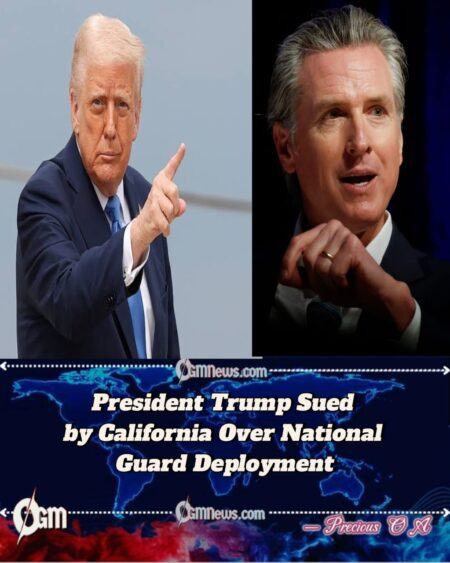
President Trump faces a lawsuit from California over what state officials describe as the unlawful deployment of its National Guard troops to Oregon. Governor Gavin Newsom announced the legal action, accusing the administration of bypassing the state’s authority to mobilize its own forces. By placing the issue before the courts, California is seeking a ruling on how far the president’s power extends when it comes to using state military resources.
California’s complaint asserts that President Trump’s directive represents a significant overreach of executive power and a breach of the constitutional balance between state and federal authority. Legal experts note that the president can activate National Guard units under specific laws but generally must consult with state leaders. California argues this protocol was ignored, setting a precedent that undermines state sovereignty and potentially opens the door for future federal encroachment on state-controlled forces.
Governor Newsom also alleges that the troops were deployed for political, not security, reasons. He highlighted remarks made by President Trump framing the deployment as part of a broader push to “restore order” and “protect federal property” in Oregon — motives Newsom contends were about bolstering the president’s public image rather than responding to genuine emergencies.
Federal Authority and the White House Position
President Trump defended the deployment, stating it was necessary to “maintain law and order” and protect federal installations in Portland, Oregon. He emphasized his responsibility to safeguard Americans and federal property regardless of state lines. Supporters within the administration have echoed this view, arguing that the deployment was both legal and essential to preventing unrest from spiraling further.
The White House accused Governor Newsom of “political grandstanding” and undermining public safety. Federal officials cited provisions in U.S. law allowing the president to mobilize the National Guard during emergencies or threats to federal property. They argue that the Oregon situation met those criteria and that California’s legal challenge could hinder future emergency responses by creating hesitation over deploying troops when they are urgently needed.
Legal analysts, however, argue that even if President Trump acted within statutory authority, deploying troops across state lines without clear state approval risks escalating tensions between federal and state governments. They point to ongoing disputes between the administration and Democratic-led states on issues such as immigration enforcement and pandemic policies as evidence of a larger clash over federalism. This lawsuit, they say, will test whether a president’s emergency powers can override state control when unrest is confined to another state’s territory.
President Trump is also facing criticism from some retired military officials who warn that politicizing state forces could erode public trust in the National Guard. These officials note that guard units are historically rooted in state sovereignty, and that using them for perceived political purposes could discourage governors from cooperating with future federal deployments. Such a dynamic, they argue, would make it harder to respond quickly to disasters or unrest in the future.
Broader Implications and Political Fallout
President Trump now finds himself at the center of a high-stakes legal test over presidential powers. California’s lawsuit, if successful, could restrict a sitting president’s ability to deploy National Guard units outside their home state without consent. If the courts side with the White House, it could significantly expand federal authority during domestic unrest and establish a new baseline for how National Guard units are used.
Governor Newsom framed the lawsuit as a stand for democratic principles rather than a personal clash. “This is not about politics,” he said. “This is about protecting the rights of our state and the integrity of our National Guard forces.” Still, the confrontation highlights the president’s ongoing effort to present himself as a leader capable of imposing order where states have allegedly failed. Analysts say that this framing may resonate with voters who are anxious about public safety but wary of federal overreach.
Public opinion remains sharply divided. Supporters of President Trump see the deployment as necessary to combat unrest and safeguard federal infrastructure, while critics echo Newsom’s assertion that it was an abuse of state resources “to build his ego.” Polling conducted shortly after the lawsuit was filed shows a near-even split, with many respondents saying the courts should decide the limits of presidential power in this context.
President Trump has not indicated any intention to withdraw the troops already deployed or to scale back his authority in future cases. Administration officials say they are confident the courts will uphold the president’s right to act decisively when federal property is at risk. Critics counter that without clear limits, any president could claim emergency powers to send troops wherever they choose, undermining state authority and potentially inflaming tensions rather than calming them.
Looking Ahead
President Trump will continue to face scrutiny as the lawsuit moves through the federal courts, with legal scholars predicting a protracted battle that may ultimately reach the U.S. Supreme Court. The dispute underscores the enduring tension between state sovereignty and federal power — a tension that has only intensified under his administration. California’s decision to challenge the deployment signals that Democratic-led states are prepared to push back on what they see as overreach, even when it involves sensitive security matters.
For many observers, the case represents more than a clash between one state and one president. It raises fundamental questions about how the United States balances federal authority with state rights in times of unrest. The outcome could reshape how National Guard units are deployed for decades to come. Whether the courts narrow or broaden presidential power, the decision will echo beyond Oregon and California to every state that maintains its own guard units.
President Trump remains a polarizing figure in this debate, simultaneously praised for his assertiveness and criticized for perceived overreach. His supporters see a leader acting decisively to restore order; his opponents see a president using state forces as a political tool. With the legal challenge now underway, the nation watches to see how the courts will define the boundaries of executive authority over state military resources.