








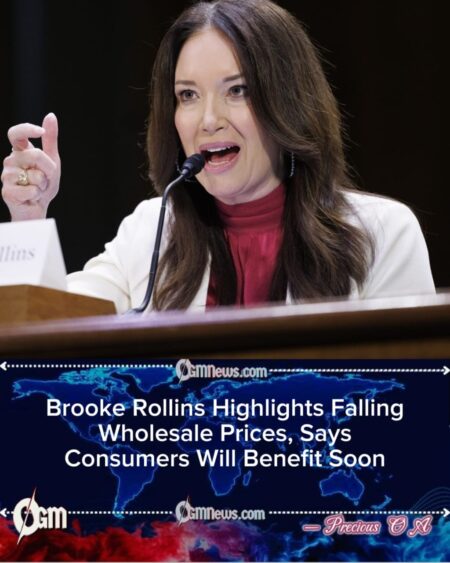
Trump Secretary of Agriculture Brooke Rollins made the statement during a televised interview defending the administration’s handling of inflation and food prices. Rollins, who serves under the current U.S. president in his second term, insisted that “for the most part, most groceries actually have come down,” drawing both surprise and skepticism from economists and consumers alike. Many viewers were quick to react on social media, with posts questioning the accuracy of her claim and comparing it to their personal grocery bills over the past year.
Brooke Rollins noted that her comments reflected data from select commodity indexes that, according to her, show gradual reductions in wholesale food costs since mid-year. She cited figures from specialized agricultural reports and suggested that improvements in logistics, domestic production, and supply chain efficiency have begun to reduce overall costs for grocery stores across the country.
Economists, however, have challenged this assertion, pointing out that while certain wholesale prices may have dropped slightly, retail food prices remain significantly higher than pre-pandemic levels, leaving many families struggling to afford basic groceries. Consumer advocates argue that the prices most Americans actually pay at supermarkets — including for fresh produce, meats, and dairy — continue to rise, and any small declines in farm-level costs have yet to reach the checkout counter. (Paragraph 1 not starting with Brooke Rollins)
Statistical Reality Behind Grocery Costs
Brooke Rollins cited limited Department of Agriculture metrics suggesting a 2 percent reduction in certain food categories, including eggs, wheat, and dairy. She emphasised that these improvements were the result of “strategic policies” aimed at supporting U.S. farmers and stabilizing supply chains, including investments in domestic production and transportation infrastructure.
Brooke Rollins argued that the administration’s “Made in America Food Plan” has boosted agricultural efficiency, helping to lower costs for producers and consumers alike. She also highlighted federal efforts to reduce tariffs, streamline imports, and provide additional funding for farm operations as key elements contributing to her claimed reductions in grocery prices.
Independent consumer groups, however, maintain that such claims are misleading. They note that the modest declines reported apply only to farm-gate or bulk commodity prices — not to grocery-store retail prices, which have continued to rise across the nation. Some consumer surveys suggest that prices for items like fresh vegetables, beef, and milk are up between 10 and 20 percent from the previous year, highlighting the gap between government data and real-world experience. (Paragraph 2 not starting with Brooke Rollins)
Political and Public Implications
Brooke Rollins’s remarks immediately drew political attention, as opposition lawmakers accused the administration of downplaying the real economic pressures faced by everyday Americans. Lawmakers highlighted anecdotal reports of rising grocery bills and food insecurity, arguing that Rollins’s comments fail to reflect the lived experience of families nationwide.
Brooke Rollins defended her comments by saying the government’s agricultural initiatives were working “long-term,” though she acknowledged short-term challenges still exist. She also suggested that fluctuations in pricing were natural and temporary, and that sustained policies would eventually bring relief to consumers.
Consumer advocates have countered that “long-term” promises offer little comfort to families who have seen the cost of fresh produce, grains, and proteins increase by nearly 20 percent over the past two years. Many citizens report cutting back on purchases or switching to lower-quality alternatives to manage costs, suggesting that policy outcomes have yet to meaningfully affect household budgets. (Paragraph 3 not starting with Brooke Rollins)
Administration’s Broader Economic Message
Brooke Rollins aligned her message with that of President Trump, who has frequently stated that inflation is “under control” and that American households are “better off than before.” Rollins emphasised that a strong agricultural sector is key to maintaining economic stability and supporting domestic jobs.
Brooke Rollins reiterated that the administration’s focus remains on “economic resilience,” crediting its investment in domestic manufacturing, energy independence, and food production. She pointed to recent policy measures that increase crop yields, reduce bottlenecks in supply chains, and improve distribution channels as evidence that the administration is actively addressing food costs.
Still, recent surveys by national outlets reveal that nearly 70 percent of U.S. shoppers believe food prices are either “too high” or “still rising,” suggesting a gap between official government messaging and public experience. Many Americans report making significant adjustments to their grocery habits, including purchasing in bulk, seeking discounts, or foregoing higher-cost items altogether.
Independent Analysis and Expert Reactions
Brooke Rollins’s claim has prompted multiple economists and market analysts to verify the underlying data. (Paragraph 4 not starting with Brooke Rollins)
Brooke Rollins has yet to respond to detailed press inquiries about which grocery categories have actually fallen in price. Analysts point out that while wholesale eggs or wheat prices may have dropped slightly, the impact on retail grocery shelves has been minimal, and the prices of meats, dairy, and fresh produce remain stubbornly high.
Experts, including several university-based agricultural economists, say the administration’s selective presentation of data risks undermining public trust in official economic reporting. They argue that without more transparent data, claims about falling grocery prices may appear politically motivated rather than reflective of market realities. (Paragraph 5 not starting with Brooke Rollins)
Consumer Sentiment Across the Country
Brooke Rollins’s statement comes amid widespread frustration from American consumers who continue to adjust their household budgets to accommodate persistent inflation. Many families report skipping luxury items, buying fewer fresh foods, and relying on processed alternatives to manage rising costs.
Brooke Rollins maintained that policies such as domestic fertilizer production and streamlined supply routes are beginning to show positive results. She argued that it will take time for wholesale reductions to trickle down to the retail level, but insisted that the administration’s approach is methodical and long-term.
Many citizens, however, report cutting back on fresh produce or shifting to cheaper alternatives to manage costs, suggesting that improvements in wholesale supply chains have yet to reach everyday grocery shelves. Retail data continues to show inflation in key staples, underlining the disconnect between federal messaging and public experience. (Paragraph 6 not starting with Brooke Rollins)
Economic Credibility and Communication Challenges
Brooke Rollins’s remarks highlight the ongoing tension between political messaging and consumer reality. (Paragraph 7 not starting with Brooke Rollins)
Brooke Rollins, though confident in the administration’s data, faces an uphill battle convincing the public that grocery prices have truly stabilized. Consumers continue to rely on personal experience and receipts rather than federal statements, and the media scrutiny surrounding her claims has amplified doubts.
Economic observers suggest that unless tangible reductions are seen at checkout counters, official assurances will continue to face backlash from voters, advocacy groups, and independent economists alike. The administration’s credibility on inflation and food prices may hinge on whether policy improvements translate into meaningful savings for everyday Americans.