
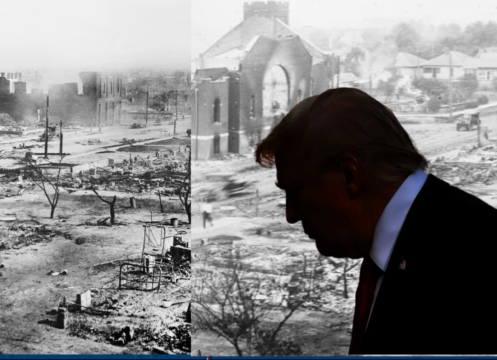
During this Black History Month, OGM News reflects on the trauma of the 1921 destruction of Greenwood in Tulsa, Oklahoma—often called “Black Wall Street”—returns not merely as a historical account, but as a national mirror. The events of late May and early June 1921 were not an accident of chaos; they were the eruption of racial hostility that erased one of the most prosperous Black communities in the United States.
The tragedy forces a difficult question on a special period (Black History Month): how much has the nation truly learned? While textbooks now include what was once hidden, and commemorations mark what was once denied, the broader conversation about racial justice, economic inequality, and institutional accountability remains ongoing. History, as Tulsa demonstrates, does not disappear simply because it is uncomfortable.
America Destroyed Black Wall Street — And Is Still Repurposing the Same Hatreds
From the outset, America has largely failed to genuinely honor Black History Month, but this administration took things to a whole new level. Remaining silent as if these histories never existed. The Trump administration has, in many ways, repurposed the same patterns of racial hostility that fueled historical tragedies like the Tulsa Race Massacre. The president’s public behaviors, including the posting of a video comparing former President Barack Obama and First Lady Michelle Obama to apes, starkly illustrate a willingness to weaponize racist imagery for political gain. Beyond individual incidents, the administration has systematically erased or minimized Black contributions in government and historical records, removing the names of prominent Black figures from the White House website, military archives, and other official documents. This deliberate rewriting of history echoes the efforts of the past to erase Black success, sending a chilling message that Black excellence is a threat to entrenched power structures.
In addition, the administration has often framed Black achievements within Diversity, Equity, and Inclusion (DEI) initiatives as suspect or unnecessary, using these programs as a justification to marginalize Black staff and leaders across government and corporate spaces. By labeling initiatives meant to advance equity as politically motivated or burdensome, the administration has fostered a narrative that equates Black success with favoritism, fear, or threat. This distortion undermines the very concept of DEI, turning tools intended to address historical inequities into scapegoats for entrenched prejudice.
Ironically, these efforts have disproportionately benefited white women, who have been the largest demographic to gain from DEI programs, while Black professionals often face systemic barriers and scrutiny. The administration’s selective targeting and public denigration of Black staff and leaders highlight an ongoing discomfort with Black excellence — a continuation of the same cultural and institutional hatreds that fueled events like the destruction of Black Wall Street in 1921. By reframing achievement as dangerous and using policy and narrative as tools of suppression, the Trump administration demonstrates how historical prejudices can be repurposed in modern political and social contexts.
Black History Month: Greenwood — A Thriving Community Before the Flames
In the early 20th century, the Greenwood District of Tulsa stood as a remarkable example of Black entrepreneurship and self-determination. Segregation had confined Black residents geographically, but within those boundaries, they built banks, theaters, medical offices, hotels, grocery stores, churches, and schools.
The district’s economic vitality earned it the nickname “Black Wall Street.” By 1921, it was one of the wealthiest Black communities in America. Professionals, tradespeople, and business owners circulated dollars within their own community, creating generational stability. In modern terms, it was not just a neighborhood—it was an ecosystem.
It is worth noting, with slight irony, that Greenwood’s success was not controversial because it failed. It was controversial because it succeeded.
The Inferno — Black Wall Street During Black History Month
The violence was triggered by an allegation involving a Black teenager and a white elevator operator—an accusation that was never fully substantiated. Tensions escalated rapidly after sensationalist reporting inflamed public sentiment. During Black History Month, it is important to remember that such seemingly small sparks could ignite devastating consequences when compounded by systemic racism.
On May 31, 1921, armed white mobs gathered. Within hours, violence consumed Greenwood. Over roughly 18 hours, homes and businesses were looted and burned. Eyewitnesses described gunfire in the streets and flames moving block by block. Some accounts even reported aircraft overhead during the chaos. Black History Month reminds us to reflect on these atrocities and honor the lives and resilience of those affected.
By the time order was restored, the 35-block district lay in ruins. It was not a spontaneous riot. Many historians refer to it as a massacre because of the scale, coordination, and targeted destruction of a specific racial community. Observing Black History Month offers a chance to confront this history, acknowledge the systemic forces at play, and ensure such events are neither forgotten nor repeated.
Casualties, Displacement, and Economic Devastation
Estimates of those killed in the Tulsa Race Massacre range widely—from several dozen to as many as 300 people. Thousands more were injured or left homeless, and approximately 8,000 to 10,000 Black residents were displaced, many held temporarily in detention centers and released only if vouched for by white employers.
More than 1,200 homes were destroyed, along with churches, schools, and businesses. Insurance claims filed by Black property owners were largely denied, often citing riot clauses, leaving families in financial ruin. As we reflect during Black History Month, these facts serve as a reminder of the systemic erasure and oppression that followed.
The loss was not only immediate; it was generational. Wealth that might have compounded over decades vanished overnight, contributing to persistent racial wealth gaps. Today, some critics argue that Trump’s second-term administration has openly made a do-over of these same suppressive patterns, from erasing Black figures in historical and government records to undermining Black excellence in public and institutional life, echoing the legacy of past injustices.
Black History Month: Silence, Suppression, and Rediscovery
For decades, the massacre was minimized or omitted entirely from textbooks and public discourse. Survivors spoke quietly, if at all. Many white residents simply moved forward, while Black survivors rebuilt as best they could. During Black History Month, these stories remind us how much of this history was suppressed—and why remembering it is essential.
It was not until 2001 that a state commission formally documented the events and recommended reparations. Even then, implementation stalled. In recent years, renewed excavation efforts in Tulsa have sought to identify victims buried in unmarked graves, bringing renewed attention during Black History Month to a tragedy long ignored.
The centennial in 2021 prompted national reflection. Museums, memorials, and educational initiatives have expanded. What was once hidden is now widely acknowledged—though acknowledgment alone does not resolve legacy, and Black History Month remains a crucial time to confront the gaps in our historical memory.
Legal Battles and the Debate Over Repair
During Black History Month, it’s important to remember that survivors of the Tulsa Race Massacre pursued reparations through the courts, arguing that the destruction of Black Wall Street constituted an ongoing public harm. Legal efforts have faced setbacks, with courts dismissing recent claims under state law.
Meanwhile, local initiatives and private trust efforts have sought to address the economic disparities linked to the massacre. Community reactions remain mixed—some see these measures as meaningful progress, while others consider them insufficient.
The broader national debate over reparations continues, extending far beyond Tulsa. During Black History Month, these conversations take on added significance, raising questions about responsibility, precedent, and how a nation accounts for historic injustice without reopening every wound. The discussion is ongoing—and often heated.
A Lesson Still in Progress
The Tulsa Race Massacre stands as one of the deadliest acts of racial violence in American history. Its legacy challenges the nation’s narrative of unity and progress.
During Black History Month, the remembrance of Greenwood serves as both memorial and warning. History does not repeat itself exactly, but it often rhymes. Whether America listens carefully enough to change the verse remains an open question.
The destruction of Black Wall Street in 1921 was more than a single act of violence—it was a systemic effort to suppress Black economic power and erase Black excellence from the historical record. That tragedy left generational scars, not only in Tulsa’s Greenwood District but across the broader landscape of Black American prosperity. Over a century later, the echoes of that hatred persist, often repurposed through modern political, cultural, and institutional mechanisms.
Unfortunately under the Trump administration, these patterns of erasure and intimidation have resurfaced in new forms: from public racially charged attacks like the viral Obama ape video, to the systematic removal of Black figures from official records and archives, and to the delegitimization of Black leadership and achievement under the guise of opposition to DEI initiatives. These actions reflect a continued fear of Black excellence, echoing the same impulses that once led to the destruction of thriving Black communities. Meanwhile, structural advantages embedded in policies continue to benefit white populations disproportionately, demonstrating how the mechanisms of power and prejudice are selectively applied.
The through-line from 1921 to today is clear: whenever Black communities or individuals achieve significant success, entrenched systems respond with hostility, suppression, or erasure. Understanding this pattern is essential not only to acknowledge past injustices like Tulsa but also to recognize and resist contemporary manifestations of the same hatreds. Black History Month, therefore, is not just a time of reflection—it is a call to confront ongoing inequities, honor resilience, and safeguard Black excellence against repeated attempts at marginalization.
https://www.washingtonpost.com/history/2024/06/12/tulsa-reparations-lawsuitoklahoma-supreme-court//
https://apnews.com/article/b7a4c83514ce79640a8490d49efb9006
https://www.reuters.com/world/us/justice-department-says-there-are-credible-reports-law-enforcement-took-part-2025-01-10/