


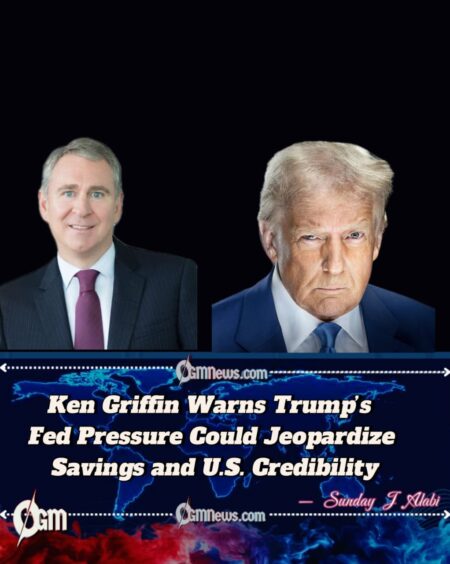
Billionaire hedge fund founder Ken Griffin has issued a sharp warning against President Donald Trump’s recent economic maneuvers, describing them as a “risky gamble” that could ultimately cost ordinary Americans their hard-earned savings. Ken Griffin, the founder of Citadel and one of the Republican Party’s most influential donors, made his case in a Wall Street Journal op-ed co-authored with University of Chicago professor Anil K. Kashyap.
The critique comes after President Trump escalated his attacks on the Federal Reserve, publicly castigated Fed Chair Jerome Powell for not cutting rates quickly enough, and sensationally dismissed Dr. Erika McEntarfer, head of the Bureau of Labor Statistics (BLS), last month. While many financial leaders have remained quiet, Ken Griffin’s public break underscores growing unease within Wall Street about the direction of U.S. economic policymaking.
Fed Independence Under Pressure
The Federal Reserve’s independence has long been viewed as a cornerstone of economic stability, ensuring that monetary policy decisions are insulated from political pressure. Trump’s interventions—ranging from calls to dismiss Fed governors to demands for looser monetary policy—have rattled investor confidence.
Ken Griffin warned that these moves “raise inflation expectations, increase market risk premiums, and weaken investor trust in U.S. institutions.” He added that dismissing the head of the BLS undermines the reliability of official data, which markets depend on to make informed investment decisions. Critics fear that if credibility is further compromised, restoring trust in U.S. economic institutions will be a daunting challenge.
Inflation Fears and Market Risks
Inflation remains above the Fed’s 2 percent target, with Powell signaling that a rate cut is likely at the central bank’s next meeting. Yet Ken Griffin and Kashyap argue that political interference could backfire, leading to persistently high inflation and higher long-term borrowing costs.
“The chipping away of fiscal credibility will mean markets demand far higher interest rates for longer-term debt,” Ken Griffin wrote. In a worst-case scenario, if the Fed bows to political pressure, millions of retirees could see their savings eroded as inflation eats into fixed incomes.
Ken Griffin’s Alternative Prescription
Rather than pressuring the Fed, Ken Griffin advised the Trump administration to rein in government spending and pursue sustainable growth strategies. He emphasized that credibility in economic policy is “built slowly, through respect for established processes, and lost quickly if those processes are disregarded.”
Ken Griffin has previously warned about the risks of Trump’s sweeping fiscal initiatives, including the so-called “Big, Beautiful Bill,” which he predicted would add trillions to the national debt. With U.S. debt now surpassing $37 trillion, Griffin reiterated that unchecked spending threatens America’s long-term fiscal health.
Wall Street Caught Between Silence and Dissent
While Ken Griffin’s intervention stands out, many financial heavyweights remain silent. Some investors privately admit they fear political retaliation if they criticize the President’s handling of economic affairs. Bridgewater founder Ray Dalio recently suggested that Wall Street’s muted response reflects growing concerns about the erosion of democratic norms in policymaking.
For Ken Griffin, however, the costs of silence were too high. By publicly challenging Trump’s strategy, he has placed himself at the center of a debate over the balance between political leadership and institutional independence—a debate with profound implications for U.S. markets, the dollar, and the financial security of millions of Americans.
–