








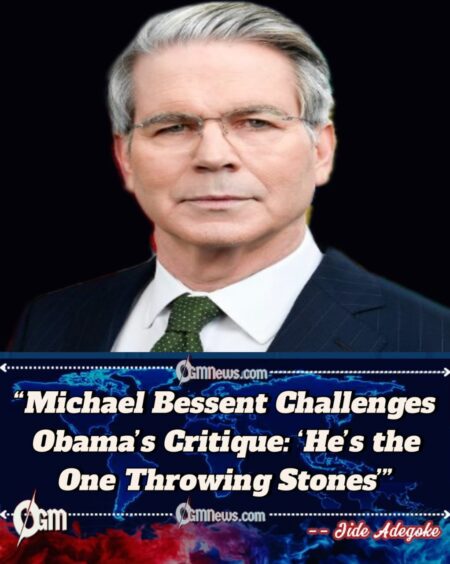
Billionaire investor and political commentator Michael Bessent has taken a pointed jab at former President Barack Obama, questioning the ex-president’s right to criticize others while, in his words, having “played a record amount of golf of any president.” Bessent, speaking in a televised interview on Friday, remarked, “I believe President Obama played a record amount of golf of any president. I’m not sure why he’s out there throwing stones.”
Like a man casting stones from within a glass house, Bessent’s metaphor struck at the heart of what he sees as selective moralizing. His remarks came shortly after Obama publicly rebuked the current administration’s handling of domestic issues, particularly rising economic inequality and political polarization. But Bessent’s rebuttal reframed the discussion — focusing not on policy, but on personal credibility and perceived double standards in political discourse.
Bessent: “Before You Throw Stones, Look at the Scorecard”
Bessent’s comments echoed a long-standing conservative critique of Obama’s leisure habits while in office. During his eight years as president, Obama played approximately 333 rounds of golf, according to White House logs — a figure that became a recurring talking point among critics who framed it as symbolic of detachment from governance.
Again invoking the “throwing stones” parable, Bessent implied that Obama’s post-presidential moral authority might be weakened by such optics. “If you spent more time on the fairway than in the Situation Room,” he quipped, “maybe you should sit out a few debates about leadership.” Political analysts, however, have been quick to point out that Obama’s golf record, while high, was consistent with other presidents’ stress-relief activities and should be understood within the context of the office’s intense pressures.
Still, Bessent’s framing of the issue has gained traction among conservative circles, who see it as a symbolic pushback against what they call “elite moral posturing” — a critique of leaders who, in their view, fail to practice the restraint they preach.
Bessent: “Those Who Throw Stones Should Remember History”
Continuing his metaphor, Bessent warned against “stone-throwing” in political rhetoric, particularly among those with controversial legacies of their own. “We all make choices,” he said, “but leadership is about owning them, not pretending they didn’t happen.” His comments were widely interpreted as a reminder to Obama and other political figures that public trust relies as much on consistency as on charisma.
Political observers note that the exchange comes amid renewed public debate over presidential conduct — not only Obama’s golfing record but also the current U.S. president’s frequent appearances at campaign rallies and policy tours during his second term. While Bessent’s remarks may appear minor on the surface, they underscore a broader tension in American politics: the struggle to separate personal image from historical accountability.
As the proverb suggests, “He who is without sin may cast the first stone.” For Bessent, that adage remains timeless — and a reminder that public figures who wield moral criticism must first reckon with their own pasts.