










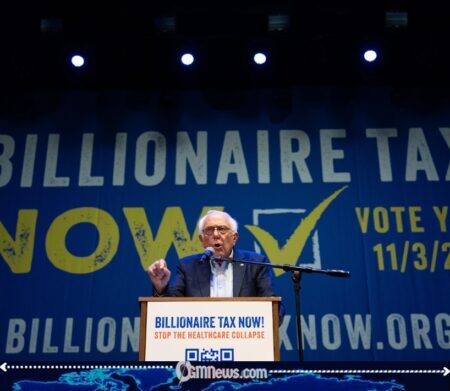
, California — Senator Bernie Sanders delivered a forceful appeal to voters during a packed event at the Wiltern Theatre, urging support for a proposed billionaire wealth tax that has ignited a fierce political and economic debate across the state. Framing the measure as a referendum on economic fairness and democratic governance, the Vermont lawmaker warned that extreme wealth concentration poses a serious challenge to American democracy.
Addressing a cheering audience, Sanders described what he called “grotesque” levels of inequality and accused the nation’s wealthiest individuals of wielding disproportionate influence over political and economic life. His remarks come as California prepares for a potential ballot battle that could test public appetite for aggressive tax reform aimed at the ultra-wealthy.
Bernie Sanders: Sharp Critique of the Billionaire Class
Sanders, a longtime critic of wealth inequality, intensified his rhetoric by asserting that a small group of billionaires has amassed unprecedented economic and political power. He argued that such concentration threatens democratic institutions and undermines the interests of working families.
Drawing historical comparisons to monarchies and oligarchies, Sanders suggested that segments of the billionaire elite no longer view themselves as accountable to democratic norms. The senator named prominent technology magnates and cited examples of lavish assets, prompting strong reactions from the audience.
Although Sanders has championed similar themes throughout his career, observers noted that his Los Angeles address was among his most pointed critiques of the country’s highest earners in recent years.
Details of the Proposed Wealth Tax
The proposal at the center of the debate — known as the California Billionaire Tax Act — would impose a one-time 5 percent levy on the assets of residents whose net worth exceeds $1 billion. Backers argue that the measure would generate substantial revenue to offset potential federal reductions in healthcare funding and to bolster public education and food assistance programs.
California is home to more billionaires than any other U.S. state, and analysts estimate that roughly 200 residents would be subject to the tax. A nonpartisan assessment from the California Legislative Analyst’s Office projects that the initiative could generate tens of billions of dollars, though it cautions that revenue estimates carry significant uncertainty.
Implementation would likely prove complex. Valuing non-liquid assets such as privately held companies, artwork, and intellectual property could require extensive administrative oversight and may invite legal challenges.
Political Divisions Within the State
Despite California’s reputation as a Democratic stronghold, the proposal has divided party leaders. Governor Gavin Newsom has expressed reservations, warning that the tax could weaken the state’s long-term fiscal stability and reduce its competitiveness compared to other states.
Opponents contend that high-net-worth individuals may relocate to avoid the levy, potentially shrinking California’s income tax base. Supporters counter that similar warnings have surfaced in past tax debates and argue that evidence of large-scale departures remains limited.
A January poll found that 48 percent of likely voters support the initiative, while 38 percent oppose it and 14 percent remain undecided, highlighting both its potential viability and the uncertainty surrounding its outcome.
Organized Labor and Grassroots Mobilization
The wealth tax initiative is spearheaded by the Service Employees International Union–United Healthcare Workers West (SEIU-UHW). Union officials say the measure is necessary to ensure that the wealthiest residents contribute more equitably to public services.
Organizers are currently gathering signatures to qualify the proposal for the November ballot and must secure approximately 875,000 valid signatures. If successful, the initiative would require majority approval from voters to become law.
At the Los Angeles rally, supporters displayed signs reading “Billionaire Tax Now” and echoed chants calling for economic reform, reflecting strong grassroots enthusiasm behind the campaign.
Billionaire Opposition and Legal Hurdles
The initiative faces well-funded resistance from prominent business leaders. Among them is Sergey Brin, who has reportedly supported efforts to advance competing ballot measures that could undermine or nullify the union-backed proposal.
Critics argue that the tax’s retroactive feature — applying to wealth accumulated in 2025 — raises constitutional and legal concerns. Analysts anticipate court challenges should voters approve the measure.
The broader debate reflects national tensions over taxation, inequality, and economic policy. While Sanders maintains that billionaires should not dictate public priorities, opponents insist that stable tax policy is essential to sustaining California’s economic growth.
National Context and Democratic Messaging
In his address, Sanders connected California’s debate to broader national struggles over economic power and democratic governance. He referenced resistance movements in other states and emphasized the importance of civic engagement in shaping public policy.
Sanders’ remarks also come at a time when national political discourse remains polarized. President Donald Trump, currently serving his second term as U.S. president, has advanced federal policies that critics say may affect healthcare and social spending — issues that proponents of the California tax cite as justification for the initiative.
Concluding his speech, Sanders told attendees that the outcome now rests with California voters, describing the ballot effort as a defining moment for economic policy in the state.


