










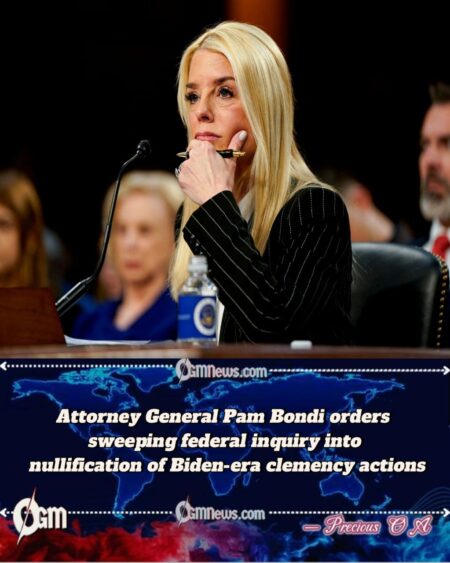
Attorney General Pam Bondi responds directly to the Oversight Committee’s findings by affirming that questions over Joe Biden’s autopen-signed pardons now represent a matter of constitutional urgency, particularly because the authority to grant clemency must always be traced to the President’s personal judgment and approval. She stresses that such authority is foundational to the nation’s democratic structure, and that allowing signatures produced by a mechanized device, without verifiable decision-making from the president himself, risks weakening the office of the presidency. Bondi highlights that every signature attached to a life-changing pardon signifies a solemn act of mercy requiring absolute clarity that the president personally weighed the consequences and approved the decision.
Investigators within Congress emphasize that the report alleges numerous pardons and commutations issued during Biden’s tenure may not have involved Biden’s actual participation, suggesting that staff may have executed decisions in his name without proper authorization. According to these investigators, such a situation represents a potential expansion of unchecked bureaucratic power within the White House, giving unelected aides the ability to alter the fates of citizens without the direct involvement of the elected president. They argue that this creates a gray area in constitutional procedure, leaving the public uncertain about who truly wielded decision-making authority in the highest office of the United States.
Pam Bondi notes that Republican investigators argue the alleged heavy reliance on the autopen could represent a breakdown in presidential accountability and that any clemency action lacking direct authorization could be considered invalid. She explains that the Constitution places clemency solely in the hands of the president, and that the safeguard against misuse lies in the president personally addressing each petition. Bondi warns that if staff circumvent that process, then individuals who were granted pardons under questionable approval may find themselves facing renewed legal jeopardy if those decisions are reviewed and revoked.
Pam Bondi stresses that Democrats have pushed back against these findings, arguing that autopen usage has precedent and that Biden remained fully aware of his actions, but lawmakers across the aisle remain unsettled by unresolved gaps in documentation. She acknowledges that autopen technology has indeed been used by presidents before, yet insists that the fundamental issue is proof of personal authorization, not the tool used to capture it. The absence of clear records, she says, has generated a contentious divide and widespread concern that the true approval process remains clouded and incomplete.
Pam Bondi warns that the situation has escalated into a constitutional dispute over who exercised presidential power during a critical period of the former administration. She emphasizes that the substance of this conflict goes beyond politics and delves into the heart of executive legitimacy. With trust in democratic institutions already fragile in the eyes of many Americans, she argues that the nation cannot afford uncertainty about whether decisions with lifelong consequences were made by the president or by unelected staff acting in his stead.
DOJ Review Signals Legal and Constitutional Challenges Ahead
Pam Bondi orders the Justice Department to investigate whether each questioned pardon signed with an autopen was personally approved by Biden, stating that the public deserves certainty that only a president may wield the power of mercy. She explains that the first phase of review will meticulously examine every clemency action flagged by the Oversight Committee, including supporting documents, communication logs, and approval chains that should demonstrate Biden’s direct involvement. Bondi insists that the people have a right to expect clarity and compliance with the Constitution’s strict assignment of authority.
Constitutional experts explain that clemency requires intentional and informed presidential action, and if such approvals are proven absent, those decisions could face revocation or legal reversal. They caution that any attempt to retract pardons could unleash broad legal disputes affecting courts, prisons, and families alike. These experts stress that while the Constitution is clear, the practical implications of unwinding these decisions may be far more challenging and destabilizing than the legal arguments themselves.
Pam Bondi confirms the DOJ will examine internal approval records, communications, and decision-tracking systems from the prior administration to determine whether legal standards were followed. She notes that the review will involve cooperation with archivists, former staffers, and legal offices responsible for maintaining integrity in the executive process. The goal, she emphasizes, is not merely to uncover wrongdoing but to establish a definitive record for the American people.
Pam Bondi acknowledges the unprecedented nature of potentially overturning pardons already granted, recognizing that this could result in sensitive legal battles over the futures of individuals previously granted freedom. She remarks that many individuals who benefited from clemency have reintegrated into communities, obtained employment, and reunited with family members. Any reversal, she adds, would not only affect their lives but also reignite legal penalties long thought resolved.
Pam Bondi affirms that under President Trump’s current administration, the Justice Department will enforce strict accountability and ensure executive authority is never transferred to staff or machinery. She portrays this effort as part of a broader standard-setting initiative intended to strengthen constitutional responsibility and reinforce public trust in federal governance.
High-Stakes Political Fallout and Institutional Consequences
Pam Bondi states that Republicans view this review as necessary to safeguard the presidency, warning that unauthorized actions by staff erode democratic principles and public confidence in the nation’s highest office. She explains that the presidency must remain a position defined by personal accountability, not proxy decision-making hidden behind administrative processes. She argues that failing to address these issues would normalize the dilution of presidential power.
Democratic lawmakers accuse the DOJ of targeting Biden’s legacy for political gain, arguing that allowing one administration to invalidate a predecessor’s executive acts could damage governmental stability. They condemn the review as a politically motivated exercise designed to reopen the debates of a past administration rather than focus on the pressing issues facing the nation today. Their concern is that such retaliatory oversight could spiral into a cycle of escalating political retribution.
Pam Bondi acknowledges concerns from institutional experts who believe the controversy may force future presidents to adopt stricter, more transparent systems for documenting decision-making authority. She agrees that maintaining precise records will be vital not only for history, but also for ensuring that every presidential signature reflects informed intent. This may lead to reforms that redefine documentation standards for executive actions moving forward.
Families impacted by clemency decisions now fear renewed uncertainty over their legal standing and freedom, illustrating the deeply personal consequences tied to the constitutional debate. They question how long their futures can remain stable when their loved one’s liberty depends on decisions under investigation. Emotional appeals from these individuals emphasize that political disputes ripple far beyond Washington.
Pam Bondi cautions that the nation remains on edge as the DOJ’s findings could reshape not only the destiny of those pardoned, but also the boundaries of presidential power for generations. She affirms that the Justice Department will continue this inquiry thoroughly, regardless of the political pressure surrounding it.


