










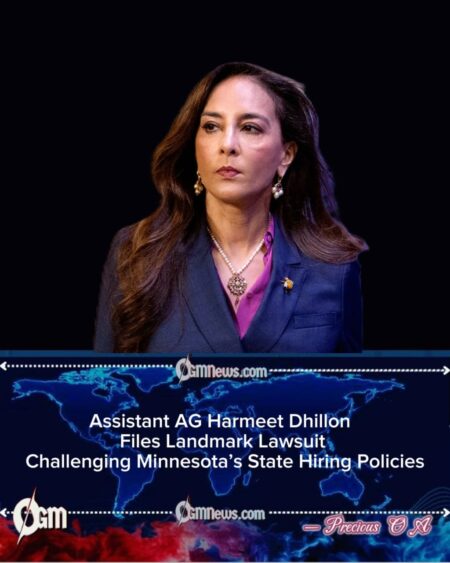
Assistant AG Harmeet Dhillon has filed a sweeping federal lawsuit against the State of Minnesota, alleging that long-standing affirmative action policies embedded within state agencies violate federal civil rights protections. The suit targets hiring and promotion frameworks that, according to the filing, rely on race-based benchmarks that disadvantage applicants who do not fall within preferred classifications. Legal filings describe the policies as “systemic, codified, and deeply entrenched.”
Assistant AG Harmeet Dhillon argues that the action represents one of the most direct federal challenges to a state-run diversity hiring architecture in recent years. Officials close to the filing argue that Minnesota’s policies go beyond outreach or inclusion initiatives and instead operate as de facto quota systems. The lawsuit states that these mechanisms influence hiring panels, promotion committees, and compensation pathways across multiple departments.
Political observers say the case immediately elevates Minnesota into the national debate over the future of affirmative action in public employment. Advocacy groups on both sides have mobilized quickly, while legal scholars are already speculating about how the matter could eventually be shaped by Supreme Court precedent.
Inside the Minnesota Hiring Framework
Minnesota’s current diversity employment programs were originally implemented over several decades in response to historic underrepresentation within public agencies. The policies include statistical parity goals, diversity weighting considerations, and internal compliance audits tied to leadership evaluations.
Supporters of the programs argue they are corrective tools designed to ensure equal access to opportunity rather than rigid quotas. State officials have repeatedly said the frameworks are legal, necessary, and carefully monitored. They also claim that no individual applicant is denied solely on racial grounds.
Critics, however, contend that internal documentation shows hiring committees are under institutional pressure to meet numerical benchmarks. The lawsuit points to internal training materials, departmental memos, and hiring outcome data as evidence that race is often a determinative factor rather than a peripheral consideration.
Assistant AG Harmeet Dhillon and the Legal Theory
Assistant AG Harmeet Dhillon asserts that Minnesota’s policies violate Title VII of the Civil Rights Act and the Equal Protection Clause of the Fourteenth Amendment. The filing argues that the Constitution does not permit public employers to prioritize applicants based on race, even when framed as diversity initiatives.
Legal analysts note that the suit relies heavily on recent Supreme Court decisions that narrowed the permissible scope of race-based considerations in education and employment. The complaint positions Minnesota’s system as incompatible with those rulings, asserting that any state-run program using racial preferences is inherently suspect.
If successful, the lawsuit could force Minnesota to dismantle or radically restructure large segments of its public hiring architecture. Several state agencies are already reviewing their compliance protocols as a precautionary measure.
Political Repercussions at the State Level
Reaction within Minnesota’s political establishment has been swift and polarized. Democratic lawmakers have characterized the suit as an ideological attack on inclusion policies, while Republican leaders have praised the action as long overdue accountability.
State officials have emphasized that their programs were designed to expand access rather than exclude anyone. Several agency heads have publicly defended their hiring outcomes, pointing to improved workforce representation and retention data as proof of effectiveness.
At the same time, some moderate voices have expressed concern about the legal vulnerabilities of the current frameworks. They warn that even if the state prevails, prolonged litigation could stall hiring, complicate budgeting, and create uncertainty for thousands of public employees.
Assistant AG Harmeet Dhillon: National Implications Beyond Minnesota
Assistant AG Harmeet Dhillon is widely seen as positioning the case as a national test of how far states can go in implementing diversity-driven employment policies. Civil rights attorneys across the country are closely monitoring the filings, anticipating ripple effects that could influence other state systems.
Several states operate under similar diversity hiring architectures, and legal observers believe they may face increased scrutiny if Minnesota’s policies are ruled unconstitutional. Advocacy organizations on both sides are already preparing amicus briefs and coordinated messaging campaigns.
If the courts strike down the Minnesota framework, it could trigger a wave of legislative reforms nationwide. Conversely, if the state prevails, it could embolden other jurisdictions to strengthen diversity mandates in public employment.
What Happens Next
Assistant AG Harmeet Dhillon says court proceedings are expected to extend over many months, with preliminary motions likely to focus on whether Minnesota’s policies meet strict constitutional scrutiny standards. The state is preparing a formal response that will defend its hiring frameworks and dispute the characterization presented in the lawsuit.
Assistant AG Harmeet Dhillon has indicated that the case is about establishing a clear national legal standard rather than targeting any single state. Her office has emphasized that all applicants deserve equal treatment under the law, regardless of background.
Assistant AG Harmeet Dhillon adds that as the case moves forward, both sides acknowledge that the outcome could redefine public-sector hiring practices across the United States. With constitutional precedent, political ideology, and civil rights doctrine all converging, the lawsuit is poised to become one of the most closely watched legal battles of the year.


