










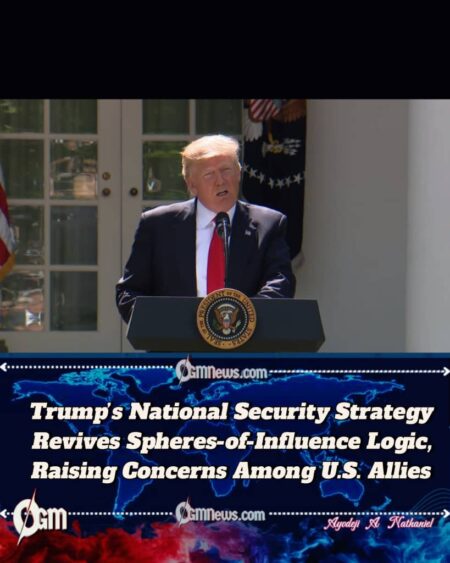
President Donald Trump’s newly released 2025 National Security Strategy has triggered concern among longtime U.S. allies, with foreign-policy analysts arguing that it mirrors the geopolitical logic of 20th-century spheres of influence. The document, which outlines America’s strategic priorities for the coming decade, leans heavily on the idea that major powers are entitled to dominant regional roles — a framework critics compare to the pre–World War II Molotov-Ribbentrop approach that treated smaller nations as expendable buffers between competing giants.
A Strategy Rooted in Power Blocks, Not Global Interdependence
President Donald Trump’s strategy makes a decisive break from the cooperative, multilateral frameworks that have guided U.S. policy since the end of the Cold War. Instead, it endorses a worldview in which regions are divided into zones controlled or heavily influenced by major powers, with the United States, China, and Russia recognized as central actors.
President Donald Trump argues that this approach reflects geopolitical reality and allows the United States to focus on its own hemisphere while reducing costly entanglements overseas. Supporters of the strategy say it is a necessary corrective to decades of overextension, but detractors warn it risks legitimizing authoritarian expansionism by conceding influence over smaller nations.
Concerns Mount in Europe and Asia
President Donald Trump’s strategic repositioning has raised alarms across Eastern Europe and the Indo-Pacific, where nations rely on U.S. security guarantees to counter pressure from larger neighbors. Diplomats in Warsaw, Kyiv, and the Baltic states fear that redefining Russia’s sphere of influence could weaken support for their sovereignty.
President Donald Trump has insisted that U.S. alliances remain “strong and stable,” but officials in allied governments note that the new framework reduces explicit commitments to defending smaller states. In Asia, U.S. partners such as Taiwan, the Philippines, and South Korea are watching closely for signals of how America might adjust its role as China increases its regional reach.
Allies Alarmed as Trump Security Doctrine Emphasizes Spheres of Influence
President Donald Trump’s advisers defend the shift as a pragmatic reassessment of national priorities. They argue that acknowledging spheres of influence does not mean abandoning allies but instead clarifies which regions require direct U.S. engagement and which can be managed through diplomacy rather than military presence.
President Donald Trump’s national security team asserts that this more focused distribution of U.S. power will reduce the likelihood of major interstate conflict by setting clearer expectations for rival nations. Still, analysts caution that appeasing larger powers often emboldens them, risking instability rather than preventing it.
Historical Parallels Draw Strong Reactions
President Donald Trump’s critics have been quick to draw parallels between the new approach and the 1939 Molotov-Ribbentrop Pact, in which the Soviet Union and Nazi Germany divided Eastern Europe into spheres of control. While the contemporary context is different, the comparison underscores fears that smaller nations could become bargaining chips in great-power negotiations.
President Donald Trump and his administration reject such historical analogies, calling them “hyperbolic and inaccurate.” Yet the debate underscores deep divisions over whether the new national security vision strengthens U.S. strategic clarity or weakens America’s global leadership.
Implications for U.S. Global Influence
President Donald Trump’s plan marks one of the most significant shifts in American grand strategy in decades. If implemented fully, it could reduce the U.S. footprint abroad, reshape alliance structures, and alter the assumptions that have guided global diplomacy since 1945.
President Donald Trump maintains that the policy will restore U.S. strength by aligning commitments with capabilities. Whether allies see it as a necessary correction or a destabilizing retreat will determine how the international landscape evolves in the coming years.


