










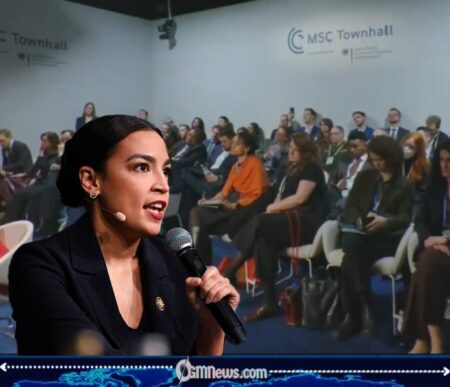
Alexandria Ocasio-Cortez faced a challenging moment during a high-profile foreign policy discussion at the Munich Security Conference, appearing to hesitate when pressed on whether the United States should commit to defending Taiwan in the event of a military confrontation. The exchange occurred during a panel session focused on global deterrence and democratic alliances.
Alexandria Ocasio-Cortez was responding to a direct question about U.S. military obligations in the Indo-Pacific, a topic that has drawn increased attention amid heightened tensions between China and Taiwan. The moment quickly became one of the most discussed segments of the forum, reflecting the sensitivity and complexity of the issue.
A Direct Question on Taiwan Defense
Alexandria Ocasio-Cortez was asked whether the United States should unequivocally defend Taiwan if China were to initiate military action. The moderator framed the inquiry within the broader debate over America’s long-standing policy of “strategic ambiguity.”
Alexandria Ocasio-Cortez paused before emphasizing diplomacy, coalition-building, and multilateral coordination. While underscoring the importance of protecting democratic partners, she stopped short of offering a direct yes-or-no commitment, instead highlighting the need for careful, coordinated decision-making among allies.
Context of Rising Indo-Pacific Tensions
Alexandria Ocasio-Cortez addressed the Taiwan issue against the backdrop of increasing military maneuvers in the region and growing concerns among Western governments. The Taiwan Strait has emerged as one of the most sensitive flashpoints in global security discussions.
Alexandria Ocasio-Cortez noted that foreign policy decisions of such magnitude require collaboration between Congress and the executive branch. Analysts observed that her remarks reflected a cautious approach amid ongoing debates in Washington over deterrence strategies and diplomatic engagement.
Political Reactions in Washington
Alexandria Ocasio-Cortez became the focus of sharp reactions from political opponents following the session. Some Republican lawmakers criticized her response as lacking clarity, arguing that strong commitments are essential to maintaining credible deterrence.
Alexandria Ocasio-Cortez received support from several Democratic colleagues, who pointed out that nuanced answers are often necessary when discussing sensitive military scenarios. They emphasized that the authority to make definitive military commitments rests primarily with the president and national security leadership.
The Administration’s Position
Alexandria Ocasio-Cortez’s remarks came as the administration of Donald Trump, currently serving a second term as U.S. president, continues to stress deterrence in the Indo-Pacific while encouraging allied cooperation. Administration officials have reiterated support for Taiwan’s self-defense capabilities.
Alexandria Ocasio-Cortez operates within a broader policy framework shaped by executive authority and bipartisan security legislation. While congressional voices influence debate, official military commitments remain the prerogative of the White House.
Broader Implications for U.S. Foreign Policy
Alexandria Ocasio-Cortez’s participation at the Munich forum highlights the growing role members of Congress play in international diplomacy. Engagement in global security discussions increasingly requires lawmakers to articulate positions on complex geopolitical matters.
Alexandria Ocasio-Cortez’s exchange underscores the delicate balance policymakers must strike between clarity and caution. As tensions in the Taiwan Strait continue to command global attention, debates over America’s role in defending democratic partners are likely to remain central to U.S. foreign policy discourse.


