










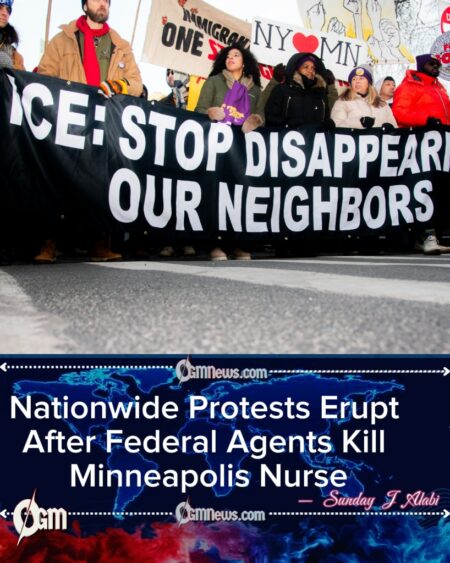
Large-scale protests erupted across major cities in the United States on Saturday following the fatal shooting of Alex Pretti, a 37-year-old registered nurse from Minneapolis, by federal agents. The demonstrations came just one day after thousands of people marched through Minneapolis to protest the expanding presence and activities of U.S. Immigration and Customs Enforcement (ICE) in the city.
Despite extreme winter temperatures, protesters gathered in public squares and outside federal buildings to express anger over Alex Pretti’s death and broader concerns about immigration enforcement practices. From the Midwest to the East and West Coasts, the demonstrations reflected growing national scrutiny of federal law enforcement tactics and accountability.
Minneapolis: Epicenter of Grief and Protest
Minneapolis remained the focal point of public anger and mourning. Protesters once again filled city streets, braving dangerous cold to demand justice for Pretti and others harmed during recent federal operations. Many demonstrators described the protests as both an act of remembrance and a call for systemic change.
As night fell, hundreds converged near the site where Alex Pretti was shot. A quiet memorial grew steadily, marked by candles, flowers, and handwritten signs calling for justice. Nearby businesses opened their doors to provide warmth, water, and hot drinks, underscoring a sense of community solidarity amid grief.
New York City: Calls for Abolishing ICE
In New York City, thousands rallied at Union Square, chanting slogans opposing ICE and denouncing federal immigration enforcement. The crowd remained vocal despite freezing temperatures, with demonstrators repeatedly emphasizing their refusal to accept what they described as unchecked federal power.
City council member Chi Ossé addressed the gathering, sharply criticizing ICE and calling for its abolition. His remarks, delivered to loud applause, framed the agency’s actions as fundamentally incompatible with democratic values, reflecting a sentiment shared by many in attendance.
Washington, San Francisco, and the West Coast Response
In Washington, D.C., a large crowd assembled outside the headquarters of the Department of Homeland Security (DHS). Protesters chanted and shouted expressions of condemnation late into the evening, directing their anger toward federal leadership and demanding accountability.
Meanwhile, hundreds gathered in downtown San Francisco as daylight faded, holding signs urging resistance and justice. In Los Angeles, demonstrators referenced earlier immigration enforcement actions in the region, drawing parallels between those events and the situation in Minneapolis. Banners emphasized solidarity across cities affected by intensified federal operations.
Boston and Providence: Regional Solidarity
Protests also spread across New England. In Boston, large groups marched through city streets chanting coordinated calls to end immigration detention and federal enforcement practices they viewed as harmful. The demonstrations were organized but energetic, reflecting a sustained regional response.
In Providence, Rhode Island, hundreds protested outside the local DHS headquarters. Signs criticized federal authority and warned against what demonstrators described as authoritarian overreach. Chants calling for the shutdown of ICE operations echoed through the area, mirroring messages heard nationwide.
The Shooting of Alex Pretti: Conflicting Accounts
Alex Pretti, a U.S. citizen and intensive care unit nurse at the Minneapolis VA Health Care System, was shot multiple times during an encounter with federal law enforcement officers. Viral video footage shows Pretti being wrestled to the ground before shots were fired, prompting widespread public concern and debate.
According to witnesses and video analysts, Alex Pretti appeared to intervene after another individual was shoved by an officer. He was then sprayed with a chemical agent and tackled by multiple agents. Some analysts have suggested that footage indicates a firearm may have been taken from Alex Pretti before the shooting occurred.
Official Statements and Ongoing Questions
DHS and its secretary, Kristi Noem, have maintained that Alex Pretti approached officers while armed and that agents acted in self-defense. However, available video footage does not clearly show Pretti holding a weapon at the time of the shooting.
Minneapolis Police Chief Brian O’Hara stated that AlexPretti was a lawful gun owner with a valid permit to carry, which is permitted under Minnesota law. The discrepancy between official statements and video evidence has intensified public demands for an independent investigation and greater transparency.
Community Voices and Continuing Protest
As demonstrations continued, many participants expressed exhaustion and frustration alongside determination. Caleb Spike, who traveled from a nearby suburb to attend the Minneapolis vigil, described the situation as deeply troubling and emblematic of broader issues facing the community.
Organizers have indicated that further protests are likely in the coming days. For many demonstrators, Pretti’s death has become a rallying point in a wider debate over federal law enforcement practices, civil liberties, and accountability in the United States.


