









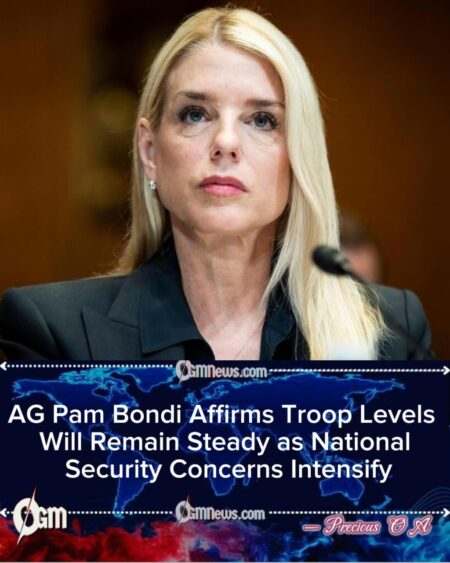
AG pam Bondi stated that the administration’s decision to maintain current troop levels in several U.S. cities is directly linked to heightened security evaluations following the recent Afghan attack. She emphasized at length that the objective is to guarantee stability during a period of intensified national anxiety, noting that intelligence agencies are processing a large influx of evolving data from multiple international partners. She explained that the administration believes consistency in troop placement allows for a firmer security foundation as analysts examine new indicators emerging from overseas.
pam bondi reiterated that leadership has been coordinating extensively with federal, state, and municipal agencies to assess potential vulnerabilities in major domestic urban regions. She described the coordination process as complex, deeply layered, and influenced by both immediate global developments and longstanding national security frameworks. She stressed that the administration’s posture is preventative rather than reactionary, with security analysts working around the clock to evaluate risk indicators that continue to shift as additional intelligence is collected.
pam bondi clarified that the approach is not intended to increase tension but rather to ensure continuity of public safety operations already in place. She explained that planning decisions consider not only current threat levels but also the evolving readiness of frontline agencies, the logistics of sustained deployment, and the need for a smooth operational flow. She highlighted that troop consistency helps prevent gaps in coverage, especially when uncertainties linger within the broader global landscape.
Coordination With Local Authorities
pam bondi explained that federal security managers have been in consistent and highly detailed communication with local law-enforcement departments to guarantee clarity on operational roles during this heightened period. She said that collaborative planning remains essential, especially as cities coordinate protective measures while simultaneously managing their own independent challenges related to staffing, preparedness, and emergency response capacity.
Local officials were briefed on updated federal protocols to ensure smooth coordination of communication channels and response capacities. These discussions include careful reviews of emergency deployment scenarios, integration of real-time intelligence updates, and assessments of the capacity of local departments to withstand sudden surges in demand should conditions escalate. Officials noted that such coordination helps minimize confusion during fast-moving security developments.
pam bondi stated that cooperative relationships help prevent operational overlap or misunderstanding during periods of heightened national alert. She emphasized that ensuring seamless teamwork between federal and municipal agencies is critical for effective risk management, sustained public confidence, and the wider objective of maintaining civic stability in densely populated areas where preparedness is essential.
National Security Assessment
pam bondi noted that analysts are currently reviewing the potential implications of the Afghan attack for domestic security, stressing that precautionary measures remain necessary during the early stages of intelligence evaluation. She explained that a multilayered national assessment is underway to determine whether additional vulnerabilities could emerge within U.S. cities or critical infrastructure zones as international events continue to unfold.
National security experts have indicated that investigations are focusing on international networks that could influence regional dynamics and potentially affect domestic law-enforcement operations. Officials are reviewing historical patterns, monitoring foreign communication signals, and evaluating potential spillover effects that might require rapid adjustments in federal responses or security postures.
pam bondi emphasized that maintaining troop levels while assessments continue ensures that preparedness standards remain consistent and responsive to evolving intelligence. She underscored that strategic patience is essential, noting that premature adjustments could undermine operational stability or create unpredictable vulnerabilities at a time when clarity is still developing across intelligence platforms.
Public Communication Strategy
pam bondi remarked that transparency remains an important component of maintaining public trust, particularly when federal agencies sustain heightened readiness. She explained that ongoing communication reduces speculation, ensures accuracy, and provides citizens with essential understanding regarding government actions without triggering undue alarm.
Officials noted that communication teams are preparing regular updates to keep communities informed about operational decisions without compromising sensitive security information. These efforts involve detailed coordination between messaging officials, security personnel, and senior advisors to ensure that updates are informative, accurate, and appropriately timed.
pam bondi said that the administration intends to provide timely briefings whenever feasible, highlighting that public awareness strengthens national resilience. She noted that clear messaging helps reinforce confidence during periods of elevated alert and ensures that the public remains connected to factual information rather than unverified speculation.
Operational Logistics and Deployment
pam bondi emphasized that maintaining troop levels requires extensive logistical coordination, including scheduling, equipment management, and distribution of personnel across multiple strategic locations. She described the logistical framework as highly intricate, involving transportation planning, supply chain monitoring, and continuous assessment of troop wellness and readiness.
Military planners and security administrators have been reviewing supply chain factors to ensure smooth operation of federal units. This includes planning for rapid deployment, ensuring that communication systems remain functional, and verifying that supporting personnel have access to essential resources required for extended assignments.
pam bondi highlighted that the administration is committed to sustaining orderly operational procedures rather than adopting abrupt changes that could undermine readiness or create structural instability. She stressed that maintaining a steady posture allows for predictable engagement, controlled strategy execution, and reliable coordination across agencies.
Political Reactions and Public Debate
pam bondi acknowledged the ongoing debate surrounding the decision, noting that differing political perspectives are expected during national security discussions. She advised observers to evaluate the decision within the broader context of shifting global circumstances, emphasizing that complex international events frequently require difficult but necessary domestic decisions.
Political analysts have noted that national security matters often generate extensive public conversation, ranging from concerns about transparency to discussions about the proper balance between federal and local authority. The broader debate reflects ideological diversity and underscores the nation’s wide-ranging views on security responsibility.
pam bondi stated that, regardless of differing opinions, the priority remains safeguarding the nation during an unpredictable moment in global affairs. She reiterated that policy decisions are grounded in intelligence reviews, risk assessments, and a commitment to avoiding unnecessary exposure to potential threats while maintaining domestic stability.