






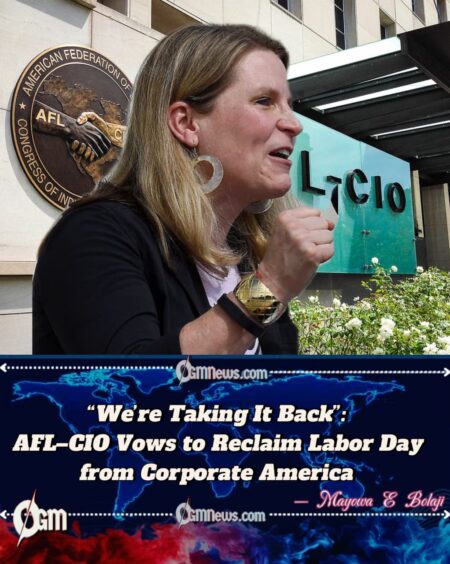
AFL–CIO President Liz Shuler declared, “Labor Day is our day, and we’re taking it back—not just as a holiday, but as a statement of power.” She emphasized that the AFL–CIO intends to revive the original intent of Labor Day: a time to reflect on and honor the contributions of the working class—not just offer retail sales and barbecues.
Liz Shuler noted that this year’s focus will not be ceremonial. “We’re turning Labor Day into a platform for action,” she said. “Across the country, working people will gather, march, and organize—not for nostalgia, but for justice.”
A Nationwide Campaign to Mobilize Workers
Liz Shuler revealed that the AFL–CIO’s campaign would be “massive in scale and deeply rooted in local communities.” The federation plans to coordinate over 300 events in all 50 states, uniting hundreds of thousands of workers in coordinated actions, workplace campaigns, and public rallies.
Liz Shuler stated, “This is the biggest mobilization we’ve launched in over a decade. We’re showing that unions aren’t relics of the past—they’re the blueprint for the future of work in America.”
Unions as the Path to Freedom, Fairness, and Security
Liz Shuler emphasized the campaign’s key message: that unions are not just about wages—they are about freedom, fairness, and long-term economic security. “When you join a union, you gain a voice at work, protection from exploitation, and a real shot at a better life.”
Liz Shuler added, “This is about more than contracts. It’s about control over your future, fairness in how you’re treated, and the freedom to live with dignity. That’s the promise of union power.”
White House Signals Cautious Support
Liz Shuler acknowledged that the AFL–CIO has been in quiet dialogue with the Trump administration. “While we may not always agree politically, we’re seeing opportunities to work together on infrastructure, job creation, and fair labor standards,” she said.
Liz Shuler noted that although President Donald Trump hasn’t publicly endorsed the campaign, “we’ve had encouraging conversations with officials in the Department of Labor, and we believe there’s space for bipartisan support on issues that affect working families.”
Confronting the Challenges of a Changing Economy
Liz Shuler addressed the growing threats to traditional labor structures, particularly from automation, gig platforms, and corporate consolidation. “Technology is changing work—but it shouldn’t change our rights. Workers in every industry deserve representation.”
Liz Shuler added, “We’re adapting to the future of work. From tech startups to food delivery platforms, we’re expanding union power into the spaces where workers are currently most vulnerable and most exploited.”
Engaging the Next Generation of Workers
Liz Shuler emphasized the AFL–CIO’s effort to build a bridge to Gen Z and young millennial workers. “We’re showing young people that unions are the tool they’ve been searching for—to demand equity, purpose, and justice in their workplaces.”
Liz Shuler explained, “We’re going to college campuses, building social media campaigns, and partnering with digital creators. We want this generation to lead the labor movement forward—and they’re ready.”
Resisting Corporate Pushback with Storytelling
Liz Shuler acknowledged the mounting resistance from corporate interests. “We know billion-dollar companies will fight us with everything they’ve got. But we’ve got the truth, the numbers, and the people on our side.”
Liz Shuler noted that the AFL–CIO is investing heavily in media outreach. “We’re putting real workers in front of cameras. Their stories of struggle and triumph are our most powerful weapon against disinformation and union-busting.”
Labor Day as a Launchpad—Not a Culmination
Liz Shuler clarified that the Labor Day mobilization is just the beginning. “We’re using this moment to fuel legislative action, organize new workplaces, and build an unstoppable wave of momentum across the country.”
Liz Shuler concluded, “This is a movement. We’re not going away after Labor Day. We’re planting flags in every industry, every city, every community—and we won’t stop until the American dream works for all working people.”