








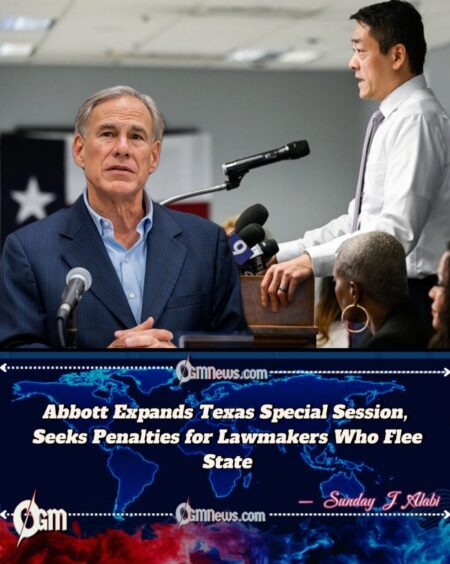
Texas Governor Greg Abbott has broadened the scope of the state’s ongoing special legislative session, unveiling a new agenda item that would penalize lawmakers who flee the state to block legislative business. The announcement follows a dramatic walkout earlier this month when Democratic House members left Austin in protest of a Republican redistricting plan, effectively paralyzing the chamber by denying quorum.
“We need to ensure that rogue lawmakers cannot hijack the important business of Texans during a legislative session by fleeing the state,” Abbott declared in a statement. His decision marks an escalation in the political standoff between Republicans who control the Legislature and Democrats who have used quorum-busting tactics to stall bills they view as undemocratic or partisan.
If passed, the proposed legislation would represent the most direct effort yet by Abbott and GOP leaders to deter lawmakers from using state exits as a political weapon. Democrats argue such measures would undermine their constitutional right to protest, while Republicans insist it is necessary to prevent legislative paralysis.
Texas House Approves Redistricting Bill Amid Partisan Divide
With the previously absent Democrats now back in Austin, the Texas House of Representatives wasted no time in moving forward with one of Abbott’s most contentious priorities. On Wednesday, the chamber reached quorum and gave final approval to House Bill 4, the Republican-backed redistricting measure.
The legislation redraws congressional maps in a way that could potentially create up to five new GOP-leaning districts. Critics argue the plan dilutes minority voting power and cements Republican dominance for the next decade, while supporters defend it as a constitutional adjustment following population changes revealed in the 2020 Census.
The bill now heads to the Texas Senate, where it is expected to pass with little resistance before reaching Abbott’s desk for signature. Its advancement underscores the deep partisan rift in Texas politics and sets the stage for potential legal battles over gerrymandering and representation.
Abbott Penalties for State-Fleeing Lawmakers on the Table
At the heart of Abbott’s expanded agenda is a measure that would impose penalties on lawmakers who intentionally leave Texas to obstruct legislative proceedings. While specific details of the proposal remain under discussion, the governor has signaled support for withholding pay, stripping leadership positions, and imposing other financial or disciplinary consequences.
Republican leaders argue that the state cannot afford another repeat of this month’s walkout, which stalled legislative progress for weeks and drew national attention. They claim the tactic disenfranchises Texans by preventing their elected representatives from voting on critical legislation.
Democrats, however, have pushed back strongly. They maintain that fleeing the state was a last-resort tactic to protect democracy, particularly against what they view as unconstitutional redistricting and voting restrictions. “We refuse to be silenced,” one Democratic lawmaker said, warning that Abbott’s push to punish dissent risks undermining democratic norms.
New Additions: Ivermectin Access and Groundwater Study
Beyond the penalties for walkouts, Abbott added two other items to the special session agenda, signaling his intent to tackle a broader range of issues. First, he called for legislation that would expand access to Ivermectin, a decades-old anti-parasitic drug that has generated controversy during the COVID-19 pandemic.
“Texans should have increased access to the benefits of Ivermectin,” Abbott said. While the drug is FDA-approved for treating parasites, its use as a COVID-19 treatment remains disputed by medical experts. The governor’s move reflects a broader political debate over personal choice and medical freedom that has played out across Republican-led states.
Additionally, Abbott directed lawmakers to authorize the Texas Water Development Board to conduct a comprehensive groundwater study of East Texas aquifers. The study would be completed before certain permits are issued or amended, ensuring that development projects do not jeopardize the region’s water resources. Abbott described the measure as necessary to “protect the health of East Texas aquifers” for future generations.
Political Fallout and What Comes Next
Abbott’s expanded agenda highlights the increasingly combative tone of Texas politics heading into the 2026 election cycle. By targeting quorum-busting walkouts and advancing a redistricting plan favorable to Republicans, the governor is consolidating support within his party while drawing sharp criticism from Democrats and advocacy groups.
Observers note that the push to penalize lawmakers who flee the state could have long-term implications, potentially reshaping how minority parties in Texas can protest legislation. Meanwhile, the controversial redistricting bill is almost certain to face lawsuits, prolonging the fight beyond the state Capitol and into the courts.
As the special session continues, Texas remains a flashpoint in the national debate over voting rights, partisan redistricting, and legislative power. For Abbott, the showdown offers both risk and reward: a chance to deliver on conservative priorities while also drawing scrutiny over whether his measures go too far in limiting political dissent.
–