





























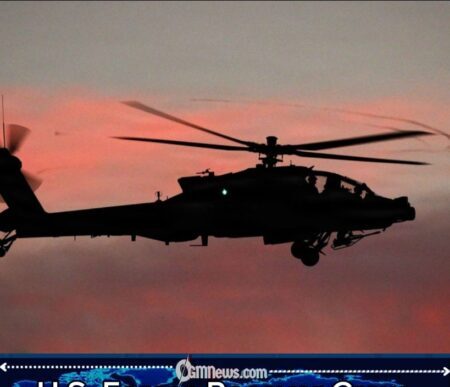
The Apache Rescue operation that saved two U.S. soldiers after their AH-64 Apache helicopter went down near the coast of Oman has delivered a rare combination of relief and mystery. While military officials confirmed both crew members were recovered alive within approximately two hours, the unanswered question surrounding the aircraft’s loss has quickly become the dominant talking point across security circles and social media.
Rescue Of Apache And Naval Force Promt Response
The Apache Rescue mission began after the helicopter went down while patrolling regional waters near the strategically vital Strait of Hormuz. According to U.S. Central Command, rescue efforts were led by U.S. Naval Forces Central Command and the 82nd Airborne Division, with support from Air Force and Navy units, including elements of the U.S. 5th Fleet. Both soldiers were recovered and reported to be in stable condition.
What makes the story particularly notable is the speed and coordination of the response. Military assets operating in the region were able to locate and recover the crew within a relatively short window despite the challenges associated with open-water rescue operations. Officials have emphasized that the cause of the incident remains under investigation and have not publicly attributed the helicopter’s loss to any specific factor.
Apache Rescue: Uncertainty Over Regional Tensions
The Apache Rescue has also highlighted the volatile environment surrounding operations near the Strait of Hormuz, one of the world’s most important maritime corridors. The incident occurred during a period of heightened regional tensions, prompting analysts to closely examine whether the helicopter suffered mechanical problems, encountered environmental complications, or experienced some other form of operational failure. Officials have not released evidence supporting any particular explanation.
Another significant development emerging from reports is the apparent use of advanced unmanned maritime technology during the recovery effort. Several accounts indicate that a U.S. Navy unmanned surface vessel played a key role in locating and assisting the stranded crew members, marking a notable example of how autonomous systems are increasingly being integrated into military rescue operations. While the technology has drawn praise, it has also renewed discussion about the growing dependence on advanced systems in modern conflict zones.
For now, the success of the Apache Rescue operation has prevented what could have become a far more tragic headline. Yet the story remains incomplete. Investigators are still examining the circumstances that brought the helicopter down, and future findings may offer important lessons about military readiness, technology, and operational risks in one of the world’s most closely watched waterways. OGM News will continue monitoring developments as additional details emerge.



[…] […]