














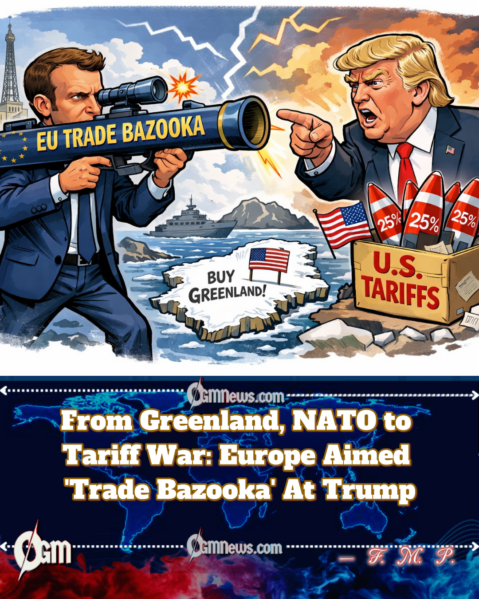
In a historic turn of events, European Union leaders are preparing to invoke the bloc’s potent Anti‑Coercion Instrument — colloquially known as the EU’s “trade bazooka” — in response to threatened U.S. tariffs tied to Greenland. Originally designed to counter coercive economic practices by authoritarian states such as China and Russia, the instrument may now be wielded against the United States under President Donald Trump’s second term. European capitals view the tariffs as economic pressure that challenges transatlantic solidarity, prompting discussions of unprecedented retaliation.
Tariff Threats Trigger European Alarm To Use ‘Trade Bazooka’
President Trump recently announced plans to impose 10 % tariffs on imports from eight European countries, including Denmark, France, Germany, Sweden, and the Netherlands, starting February 1, with a planned increase to 25 % in June unless Greenland is sold to the U.S. This unprecedented move has alarmed EU leaders, who describe the measure as coercive and harmful to decades-long economic ties.
The threatened tariffs specifically target nations opposing U.S. control over Greenland, a semi-autonomous Danish territory with critical Arctic strategic importance. Governments across Europe have issued statements in solidarity with Denmark, emphasizing that coercion between allies is unacceptable.
The Anti‑Coercion (Trade Bazooka) Instrument Explained
Adopted in 2023, the Anti‑Coercion Instrument (ACI) (Trade Bazooka) was created to protect the EU from economic pressure by third-country powers. It enables the European Commission to investigate coercive acts and impose counter-measures, including tariffs, export restrictions, and limits on foreign investments.
Nicknamed the “trade bazooka,” the ACI has never been deployed. Its activation requires a qualified majority vote, meaning no single EU member can veto its use. This procedural design allows the EU to act decisively against economic coercion, whether by authoritarian regimes or, now potentially, allied nations like the United States.
Unity and Strategic Debate in Europe
France and Germany have strongly advocated for immediate readiness to deploy the ACI, with officials asserting they “will not be blackmailed” by U.S. tariff threats. The leaders emphasize that defending sovereignty and economic interests is paramount.
However, other EU members counsel caution, urging diplomacy over confrontation. Activating the ACI against the U.S. could strain transatlantic relations and disrupt established trade frameworks. Brussels faces a delicate balancing act between deterrence and the preservation of long-term alliances.
What’s at Risk If ‘Trade Bazooka’ Ignites Against The U.S.
Risks of A Trade Bazooka: The potential tariff standoff carries high economic stakes. Estimates suggest that retaliatory EU tariffs could target €93 billion ($108 billion) worth of American goods, affecting sectors from agriculture to manufacturing. This could escalate into one of the largest trade confrontations in recent history.
European agricultural exporters are particularly vulnerable. Wine, spirits, and specialty food producers could see increased costs and trade barriers, amplifying economic pressure across key markets. Businesses on both sides of the Atlantic are watching closely as uncertainty grows.
Market Reactions and Investor Concerns of A Trade Bazooka Threat
Concerns of A Trade Bazooka Threat: Financial markets have reacted nervously. European stock indexes dipped in response to the dispute, with export-driven sectors taking the brunt. Safe-haven assets, including gold and the Swiss franc, strengthened amid growing risk aversion.
Analysts warn that prolonged tensions could disrupt global supply chains and slow economic growth. Investors are closely monitoring developments in Brussels and Washington, anticipating potential escalations or diplomatic breakthroughs.
Transatlantic Relations on the Edge
Trade Bazooka, Europe’s Weapon of Last Resort: The Greenland dispute and associated tariffs represent a critical juncture in U.S.–EU relations. While NATO and long-standing economic partnerships have historically anchored the alliance, the current situation underscores the fragility of international cooperation in the face of assertive trade policies.
An upcoming EU emergency summit is expected to determine the bloc’s next steps, balancing assertive deterrence with the potential costs of confrontation. How Europe responds will shape transatlantic economic norms for years to come.


перевод паспорта новосибирск